

 6 Min Read
Public expectations of business are rising, and so is scrutiny of how companies show up on the issues that matter. To help leaders understand this shifting landscape, Page partnered with The Harris Poll on the 2026 Page–Harris Poll Confidence in Business Index, a global study of how people view business across 14 markets.
- What we found: Economic stability tops citizens’ global concerns. Yet less than a third (29%) say they see companies taking action on key issues and clearly explaining what they are doing and why.
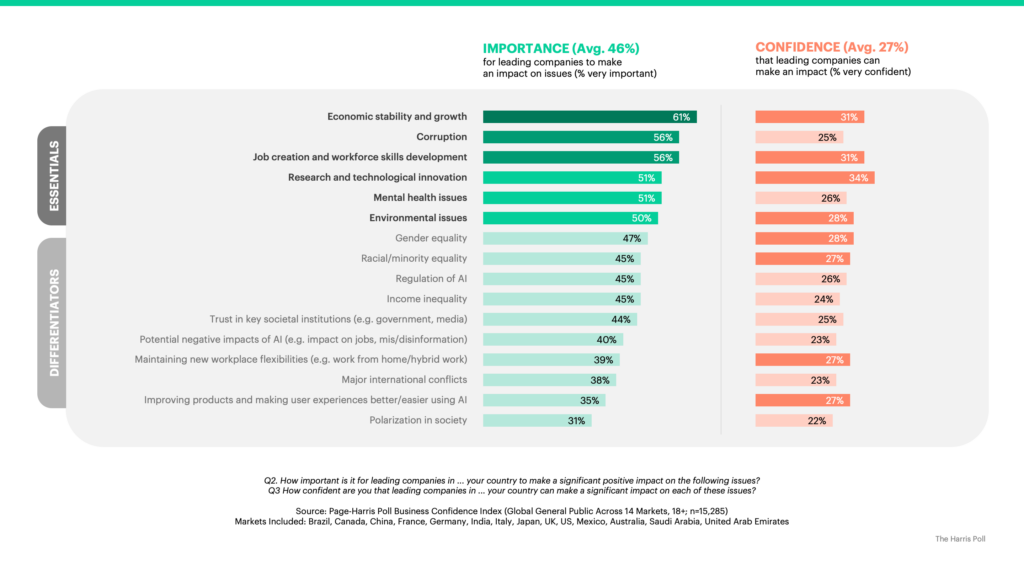
- The stat you can’t ignore: Six in ten (61%) globally expect leading companies to create economic impact for everyone. Yet, only (31%) believe they’ll deliver.
- What to consider: Public anger toward business is growing. In other Harris Poll data, Americans blame corporations and government equally for high tariffs and the cost of living. Also, nearly half of the companies in our 2025 Axios-Harris Poll 100 saw their reputations decline. At the same time, a company’s owned media channels are less impactful: Public searches for company information are less common on a firm’s website (47%) than on YouTube (55%) and social media (53%). There’s even been a +10%-pt increase in GenAI usage from 2024 (39%).
What this means: People see more potential for business to make an impact than they currently see being realized. This lagging confidence is driven less by opposition to corporate involvement and more by a lack of visible action and understanding. Corporations spooked by the culture wars should be evidence-based and avoid divisive issues, like demonstrating how they’re helping their customers/employees be better off financially.
What People Expect from Business
Across the 14 countries surveyed, there is a consistent set of core issues the public expects leading companies to address:
- Economic stability and growth
- Corruption and ethical conduct
- Job creation and workforce skills development
- Environmental issues
- AI regulation and innovation
- Research and technological innovation
- Mental health and broader societal issues
The full list of topics—including gender equality, racial and minority equality, income inequality, trust in institutions, and polarization in society—also matter but often function as differentiators. When companies engage meaningfully here, they have an opportunity to stand out.
A key pattern cuts across all issues: people see more potential for business to make an impact than they currently see being realized, creating a clear opportunity for companies that lead.
A Confidence Curve: Action and Explanation
The data make clear that lagging confidence is driven less by opposition to corporate involvement and more by a lack of visible action and understanding.
- Globally, only 29% of the public say they see companies taking action on key issues and clearly explaining what they are doing and why.
- By contrast, 71% see little action, little explanation, or neither—conditions that correspond with minimal confidence in business.
Where companies pair concrete action with clear context (explaining the rationale, partnerships, goals, and outcomes), confidence rises sharply. In today’s environment, action alone is not enough; credibility depends on making that action visible and understandable.
Generational Divides in Expectations
The study also surfaces meaningful differences by generation:
- Gen Z adults (18–28) place relatively more weight on issues like mental health, gender equality, and racial/minority equality, and look for companies to signal values clearly.
- Older generations, especially Boomers, focus more on economic stability, corruption, and jobs, and are somewhat less likely to rank social and identity‑based issues at the top.
These gaps don’t mean choosing one audience over another, but they do suggest that single‑issue, one‑message‑for‑everyone approaches are less effective. The same program may need to be framed differently for different stakeholders and this affects both issue priorities and channel strategy.
How People Learn About Companies Today
The Index also tracks where people are turning for information on companies and brands in a fragmented media environment.
Search is the starting point
Across markets, search engines (e.g., Google, Bing and local equivalents) are:
- The most frequently used source when people look up a company or brand
- The most trusted source among the channels tested
No other channel rivals search on combined usage and trust: search is the gatekeeper for reputation, not just a channel. Roughly three‑quarters of global respondents say they often use search for this purpose, and more than two‑thirds trust what they find there. For corporate communicators, that makes search visibility and credibility foundational to any reputation strategy.
A tiered ecosystem of channels
Beyond search, the research suggests three broad tiers of information sources:
- Always‑on discovery and conversation
- YouTube
- Social media in general
- Word of mouth (friends, family, coworkers)
- Depth and verification
- News media
- Consumer ratings and reviews
- Company and brand websites
- Emerging and niche sources
- Platforms such as Facebook, Instagram, TikTok and Reddit
- Dedicated generative AI tools
Use and trust vary by age group: younger adults lean more on social and video platforms, while older adults continue to rely more on news outlets and company websites. But search remains a common entry point across generations.
Generative AI: Fast-Growing, Not Yet First
Dedicated generative AI tools are still used less often than search or major social platforms, but the data suggest they are among the fastest‑growing sources people turn to for information about companies.
As generative AI tool use grows, so will expectations that AI returns accurate, current, and contextual responses about corporate activity—raising new questions about how companies structure and publish information so it can be surfaced reliably by these tools.
Why This Matters for Business Leaders
The 2026 Page–Harris Poll Confidence in Business Index underscores that:
- The public expects companies to play a serious role in economic, technological, environmental, and social issues.
- Confidence improves most when companies pair concrete action with clear explanations of what they’re doing, why they’re doing it, and what impact it is having.
- Reputation is increasingly shaped in a search‑first, GenAI‑enabled information environment, where discoverability and trust go hand in hand.
- For organizations, that means aligning business strategy, stakeholder engagement and communications around the issues that matter most to their constituents—and ensuring that story is findable and understandable wherever people are looking.
Explore the full 2026 Page-Harris Poll Confidence in Business Index now!
Methodology
The 2026 Page–Harris Poll Confidence in Business Index is based on an online survey among 15,285 adults ages 18+ across 14 countries (Australia, Brazil, Canada, China, France, Germany, India, Italy, Japan, Mexico, Saudi Arabia, United Arab Emirates, United Kingdom, United States), conducted December 5–12, 2025. Data are weighted where necessary to bring them into line with actual population proportions.