



 3 Min Read
Kids Want IRL Back.
Last year, The Harris Poll and researcher Jonathan Haidt asked kids aged 8–12 one simple question: How do you actually want to spend your time?
The answer was loud and clear: 87% wish they could spend more time with their friends in person — outside of school. 72% would rather be together in the real world than on screens. And 84% say they want to escape their phones and live more in the real world.
SHARE THIS WITH A PARENT YOU KNOW
These aren’t the words of worried parents or researchers, these are the direct wishes of Generation Alpha.
Think about the last time you saw a group of kids together. Chances are, they were side by side but staring at separate screens. Not because they chose each other less — but because that’s just become the default. The path of least resistance in a world optimized for devices.
But ask those same kids what they actually want? They’ll tell you: a friend to explore with, a game with no rules, and an afternoon with nowhere to be.

Their real world, though, is getting smaller. While kids are dreaming of more freedom, the data shows they’re getting less of it. More than half of kids aged 8–12 have never walked or biked somewhere without an adult. Nearly two-thirds have never made plans with a friend without a parent helping. The spontaneous, unsupervised afternoons that defined previous generations of childhood — building forts, knocking on a neighbor’s door, wandering until the streetlights came on — are quietly disappearing.
And the gap left behind? It’s being filled with screens.
Online, the risks are already showing up:
- 69% of kids aged 8–12 have stayed up past bedtime on a phone, tablet, or gaming device
- 23% have messaged or chatted with strangers online
- 9% have been contacted online in a way that made them feel uncomfortable
Kids don’t want more screen time. They want real life.
When given a free choice of how to spend time with friends, here’s what kids actually chose:
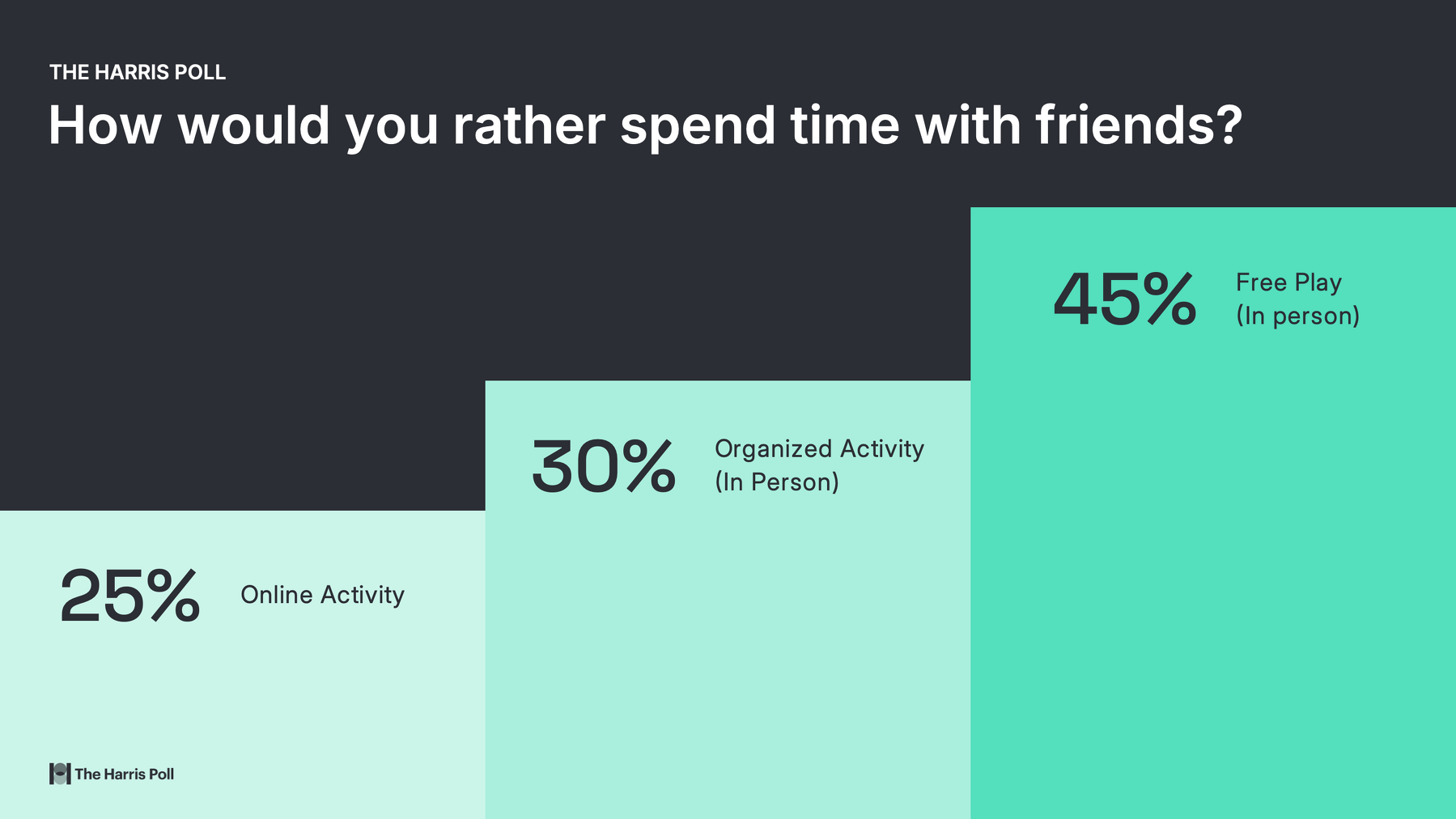
The phone-obsessed generation is a myth. Kids want to run, build, explore, and hang out face to face. They want the kind of afternoon that doesn’t have a login.
So what’s standing in the way? A culture that has traded childhood freedom for screen time, often without even realizing it. We over-schedule. We over-supervise. We hand over a device to fill the gaps. And somewhere along the way, kids stopped roaming and started scrolling.
They’re telling us they want out. It’s time we listen.