


 7 Min Read
For most of its commercial history, artificial intelligence was a story about possibility. The technology was advancing, its applications were expanding, and consumer attitudes – while mixed – were broadly shaped by curiosity rather than conviction. AI was, in the public imagination, a question mark: powerful, uncertain, and not yet personal enough to be political.
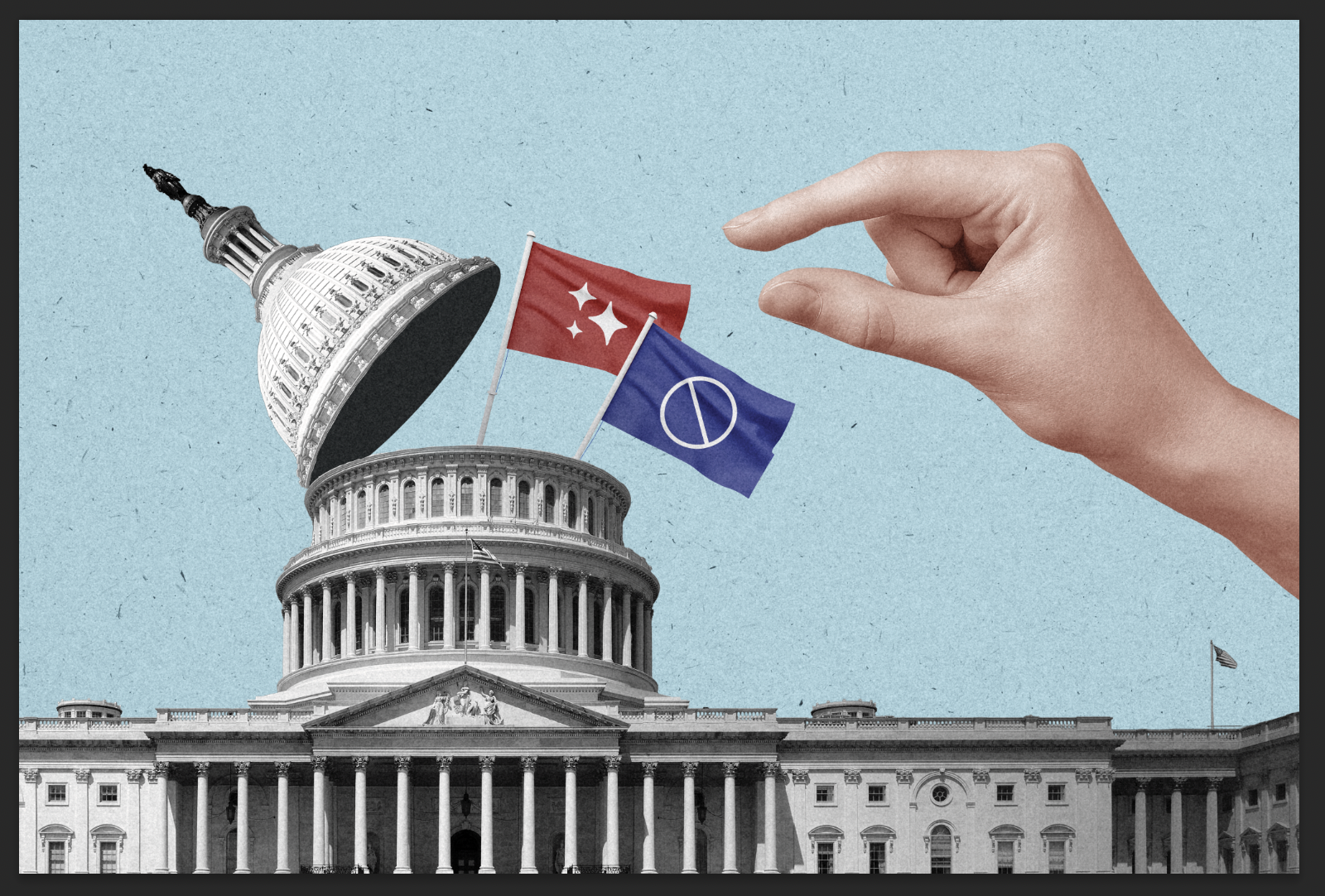
Last decade, tech companies were seen as more sympathetic to progressive values and enjoyed stronger reputations among Democrats than Republicans. Halfway through the 2020s, the industry’s push into artificial intelligence – and the concerns it has raised about job losses, environmental impact, and concentrated wealth – is reshaping how each party views Silicon Valley. These tech companies are now more highly reputable among Republicans than Democrats, steadily reversing since 2024.
What the data shows
The 2026 data presents a striking picture of diverging consumer attitudes. Democrats are growing increasingly skeptical of artificial intelligence and the companies advancing it – driven in significant part by concerns about job displacement, economic disruption, and the concentration of technological power in the hands of a small number of companies. Republicans, by contrast, are significantly more likely to trust AI companies – a dynamic shaped in part by the current administration’s embrace of the technology and its framing of AI as a driver of American economic competitiveness.
The shift reflects Democrats’ growing unease about AI’s societal impact and who stands to benefit. They are significantly more likely than Republicans to believe AI will eliminate more jobs than it creates, and significantly less likely to trust tech companies to develop it responsibly. Just as corporate America may feel it figured out how to safely navigate the culture wars of last decade, AI may be emerging as a new political fault line. Companies must now balance a difficult tension: shareholders pushing for efficiency gains on one side, and consumers and workers growing anxious about what the technology means for their future on the other.
The question the 2026 data raises – pointedly – is whether artificial intelligence is becoming, for corporate reputation purposes, what DEI became in the years prior: a deeply polarizing issue that companies in certain categories cannot avoid taking a position on, whether they intend to or not.
The parallel is instructive. DEI commitments became reputationally significant not primarily because companies sought out the controversy, but because consumer and political attention made neutrality untenable. Companies that maintained their commitments saw reputation gains among certain audiences; those that retreated saw gains among others. The reputational terrain became partisan – and the middle ground narrowed considerably.
The 2026 data suggests AI may be following a similar trajectory. For technology companies, AI-adjacent companies, and any organization that is visibly deploying or championing the technology, consumer perception is no longer shaped primarily by capability or innovation. It is being shaped by a set of questions that are fundamentally political and economic: Who benefits from this technology? Who is harmed? Whose interests does this company appear to be serving?
What this means for companies
The implications of this shift are significant – and they do not resolve neatly. There is no single strategic response to a partisan reputation dynamic that applies equally across industries, audiences, and organizational contexts. What the data does provide is a clear and evidence–based case for taking the dynamic seriously.
For companies navigating the AI reputation landscape in 2026, the most important first step is understanding where they actually stand – with which audiences, on which dimensions, and relative to the competitive landscape in their category. The gap between how higher– and lower–income Americans perceive AI companies, the divergence between partisan audiences, and the specific concerns driving negative sentiment are all measurable. And what can be measured can be understood, and what can be understood can be addressed.
The American public is not asking technology companies to stop innovating. The data does not support that reading. What it suggests is that a significant and growing portion of the public wants to understand – in concrete, human terms – what role they play in the story that AI is writing. Companies that can answer that question credibly, specifically, and without resorting to abstraction are the ones best positioned to navigate what is, by any measure, a genuinely new reputational terrain.
What comes next
The Axios Harris Poll 100 is a snapshot: a precise and nationally representative read on where the American public stands on the companies most present in their lives. But reputation does not move once a year. It moves continuously, shaped by everything a company does and says and is perceived to stand for.
The Harris Poll tracks reputation and brand health year-round, providing the kind of ongoing intelligence that turns an annual study into a living strategic asset.
If you want to understand what this year’s findings mean for your company, your category, or the landscape you are operating in, our team is ready to talk.
Methodology
The Axios Harris Poll 100 is a trusted ranking of the reputations of companies most on the minds of Americans, with a framework Harris has used since 1999. The survey findings are a result of a three-step process.
- We first surveyed 6,226 Americans from a nationally representative online sample from December 15th to 22nd, 2025, to understand the public’s top-of-mind awareness of companies that either excel or falter in society. Respondents are asked which two companies, in their opinion, stand out as having the best reputation today and which two have the worst. All nominations are compiled into an aggregate list to determine the “most visible” companies. (Subsidiaries and brands are tallied within the parent company to create a total number of nominations for each company.)
- Once we have a list of the 100 most-visible companies in America, we then deployed a second online survey to analyze those companies further. The second survey of 18,523 Americans from a nationally representative sample ran from February 13th to March 3rd, 2026. Respondents are first asked which of the 100 most visible companies from the first survey they are familiar with. From there, respondents are asked to rate two of the 100 most visible companies that they say they are “very familiar or somewhat with” on six dimensions of reputation to calculate a Reputational Quotient, or RQ®, score for each. The RQ® score determines the ranking of each company in The Axios Harris Poll 100. Each company score is comprised of a statistically significant sample size of 325 respondents weighted to be representative of the U.S. adult public on key demographics.
- Lastly, we asked a third and final set of respondents in a separate set of online surveys about contextual questions on topics related to companies and politics. The contextual findings were conducted online over two waves between April 9th to 11th and May 7th to 9th, 2026 among two nationally representative samples of 2,028 and 2,148 U.S. adults, respectively.