

 5 Min Read
Live from the Milken Institute Global Conference
An America This Week Special Report
Good morning from LA as we wrap up the twenty-ninth annual Milken Institute Global Conference, where Harris CSO Libby Rodneyand I spoke on panels on reputation amid disruption, AI-washing, and the launch of our seventh annual Milken-Harris Poll Listening Project Report. We also got to bring our podcast, “So, Get This,” to the best coast.
I spoke on a panel, “Abundance and Disruption: Re-thinking the Future of Work,” with NBC News’ Gadi Schwartz, G4’s President and Founder Tallis Gomes, Grow with Google’s Founder and Global VP Lisa Gevelber, Comcast’s EVP and Chief Impact & Inclusion Officer Dalila Wilson-Scott, and The James Irvine Foundation’s CEO Don Howard. Check out our full discussion here.
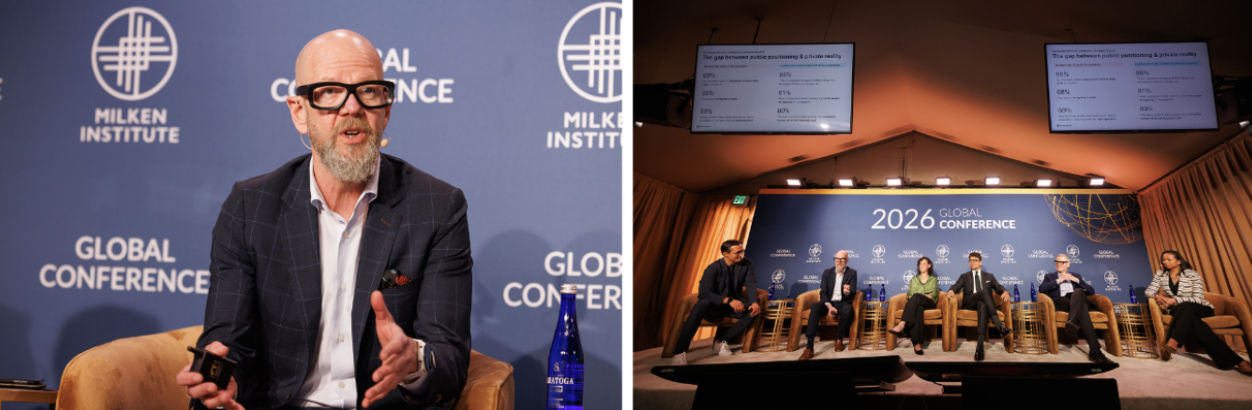
I also enjoyed moderating the “Reputation, Trust, and Culture: Assets Not on the Balance Sheet” with Tony Robbins, Principal Financial Group’s CEO Deanna Strable-Soethout, Patagonia’s CEO Ryan Gellert, and Guardant Health’s Co-Founder/CEO AmirAli Talasaz.
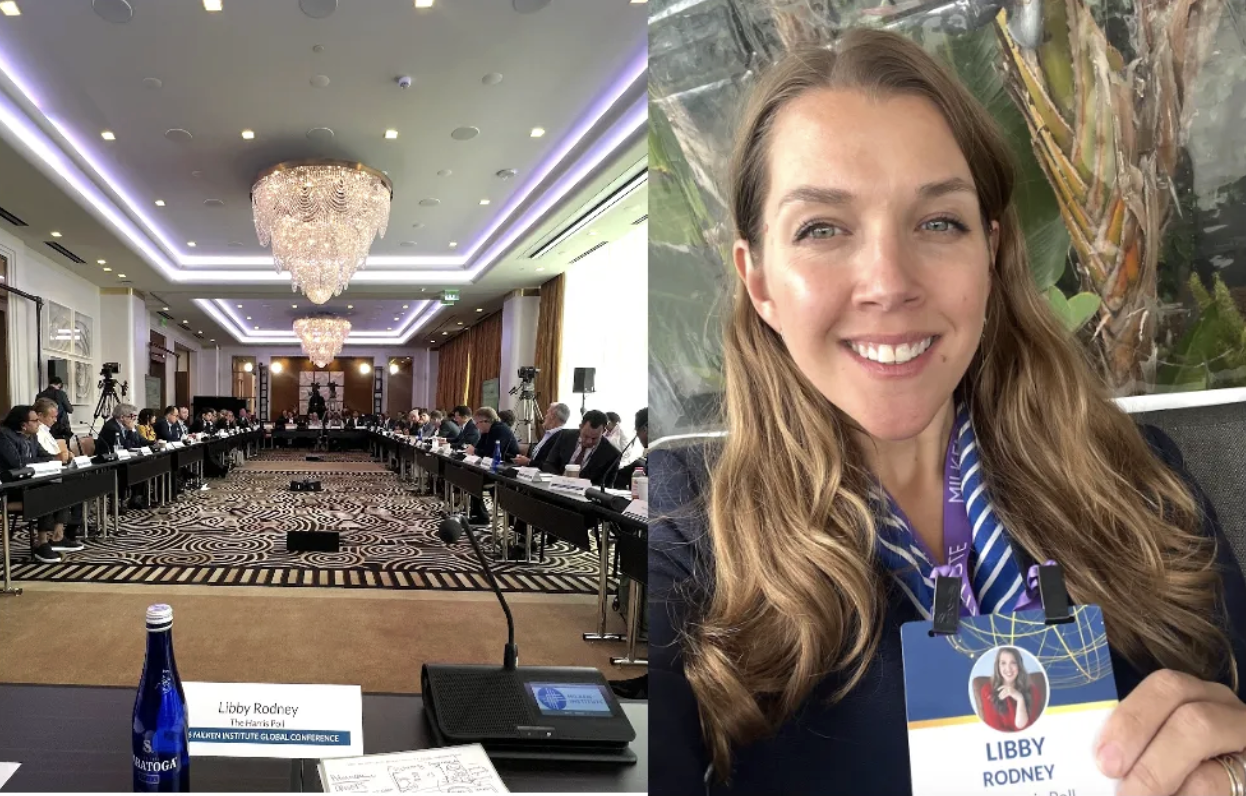
Libby briefed business leaders, politicians, public and private sector executives on our seventh annual Milken Institute-Harris Poll Listening Project, “Bridging the Technology Advancement Gap: A New Consensus for the AI Era.” Full report here.
Let’s dive in.
This year’s Listening Project focused on the AI workforce transition, speaking with Americans, professional workers, and business leaders of companies with $2B+ in revenue. What came out of the research is a story about two Americas, split not along party lines, but corner office v. cubicle. The most noteworthy insight is the significant gap between what companies promise about AI and what their workplaces are currently experiencing.
Two Groups, One Economy. Completely Different Realities.
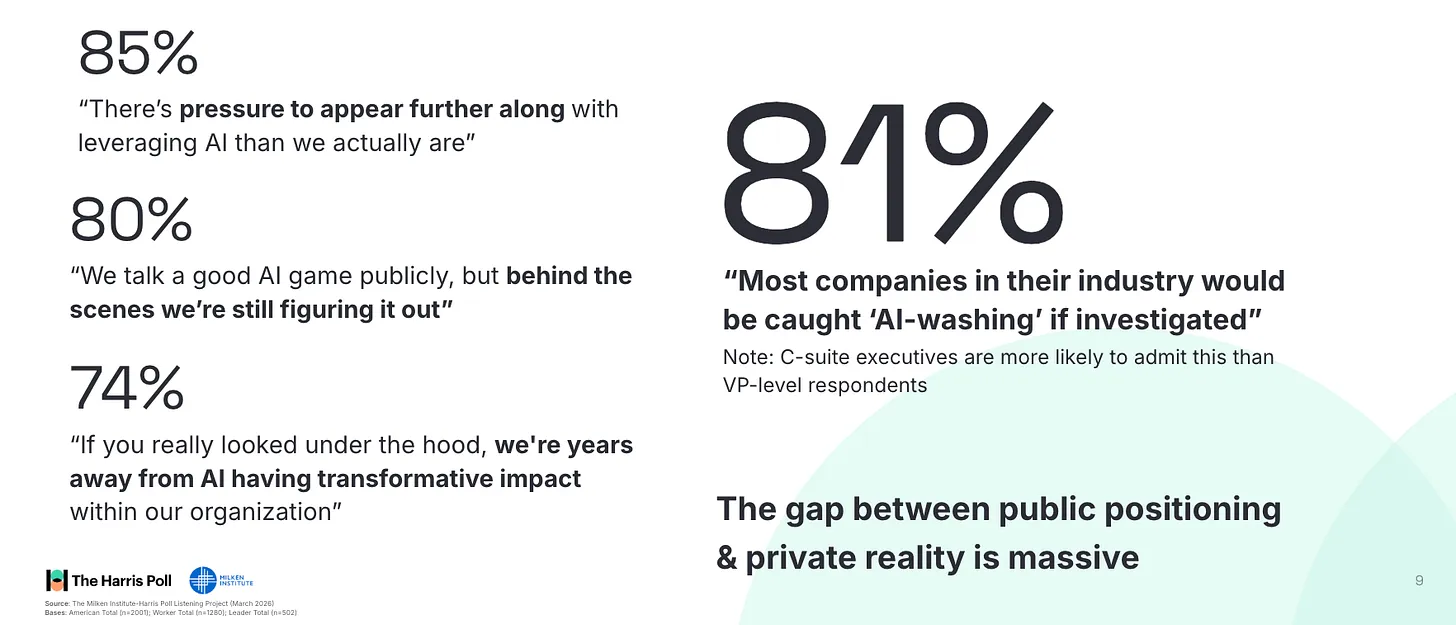
Business leaders are putting out AI smoke screens, as they aren’t as far along as everyone would care to admit. Four in five (81%) acknowledge, “Most companies in their industry would be caught ‘AI-washing’ if investigated.” Most even admit they “talk about a good AI game publicly, but behind the scenes we’re still figuring it out.”
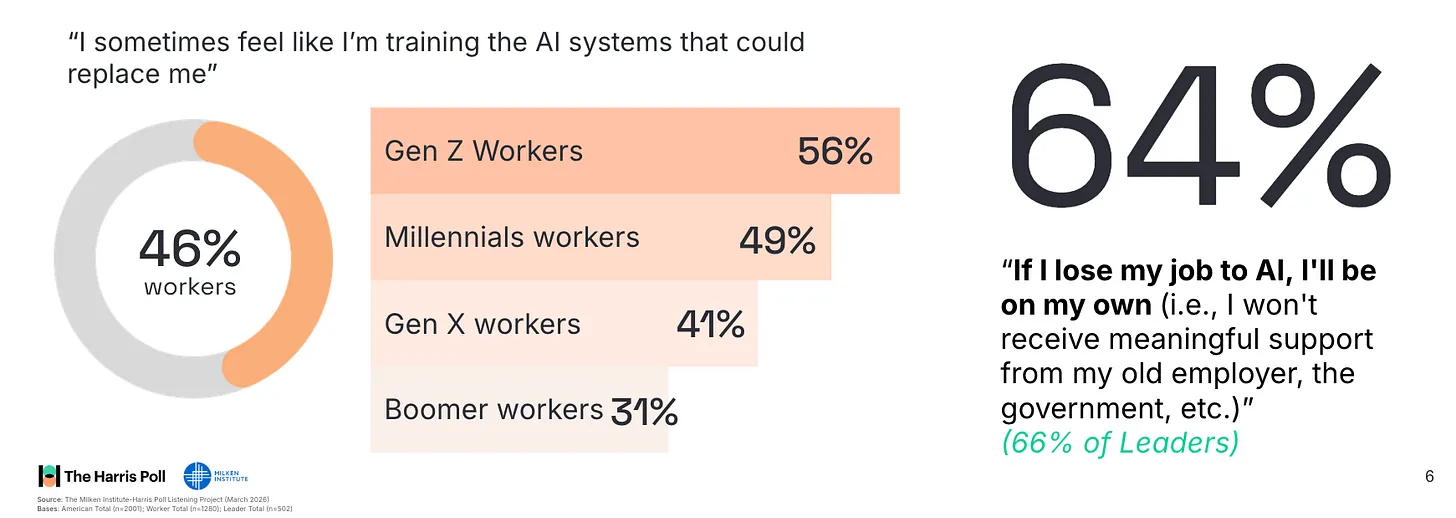
Meanwhile, American workers feel stuck experiencing the AI transition alone (68%) – and worried they might just be training their replacement. A worry nearly half of American workers are carrying, and close to three in five Gen Z workers (46% and 56%). Over two-thirds don’t know whom to trust for guidance in preparing for an AI-driven economy (70%) and find the pace of AI change leaves them unsure what skills to invest in (69%).
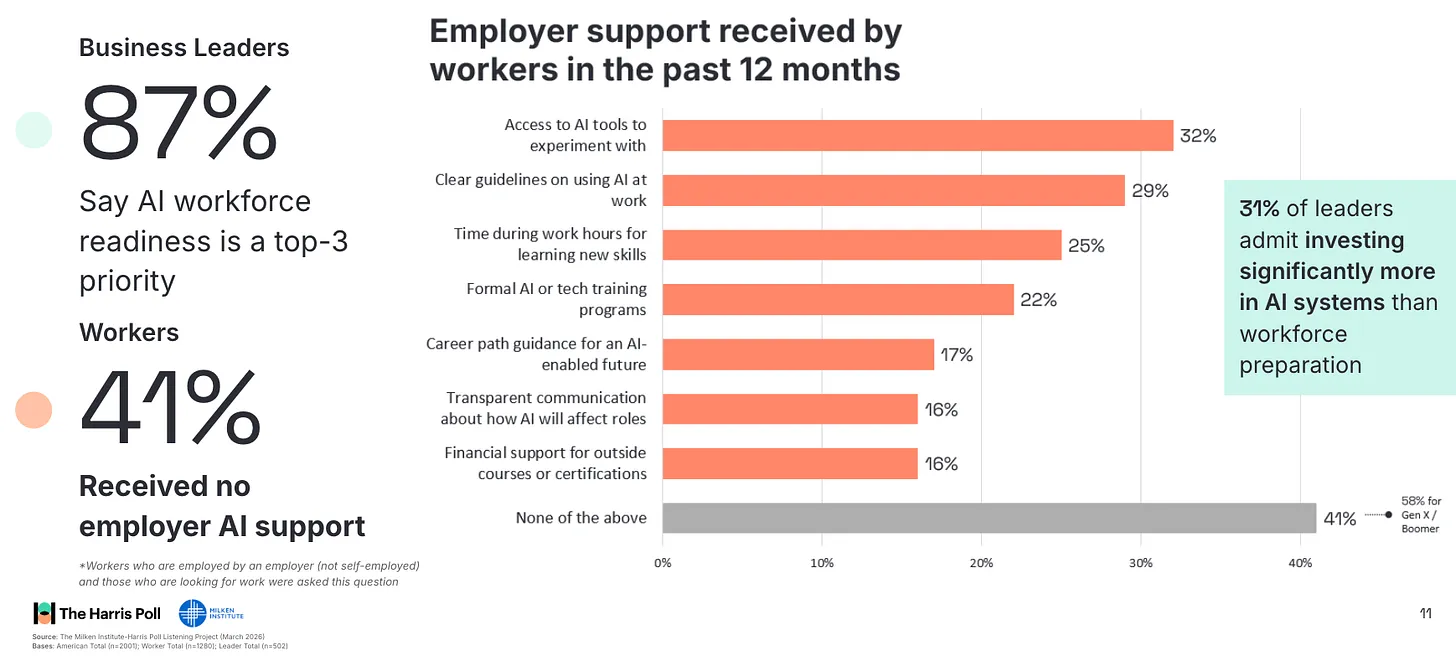
Business leaders aren’t helping. Three in five (61%) workers told us, “leadership barely talks about AI,” while leaders acknowledge the difficulty in being “fully transparent with employees about AI’s potential impact on jobs.” Nearly nine in ten business leaders report AI as a top-3 priority, yet two in five workers (41%) haven’t received any AI support from their employer.
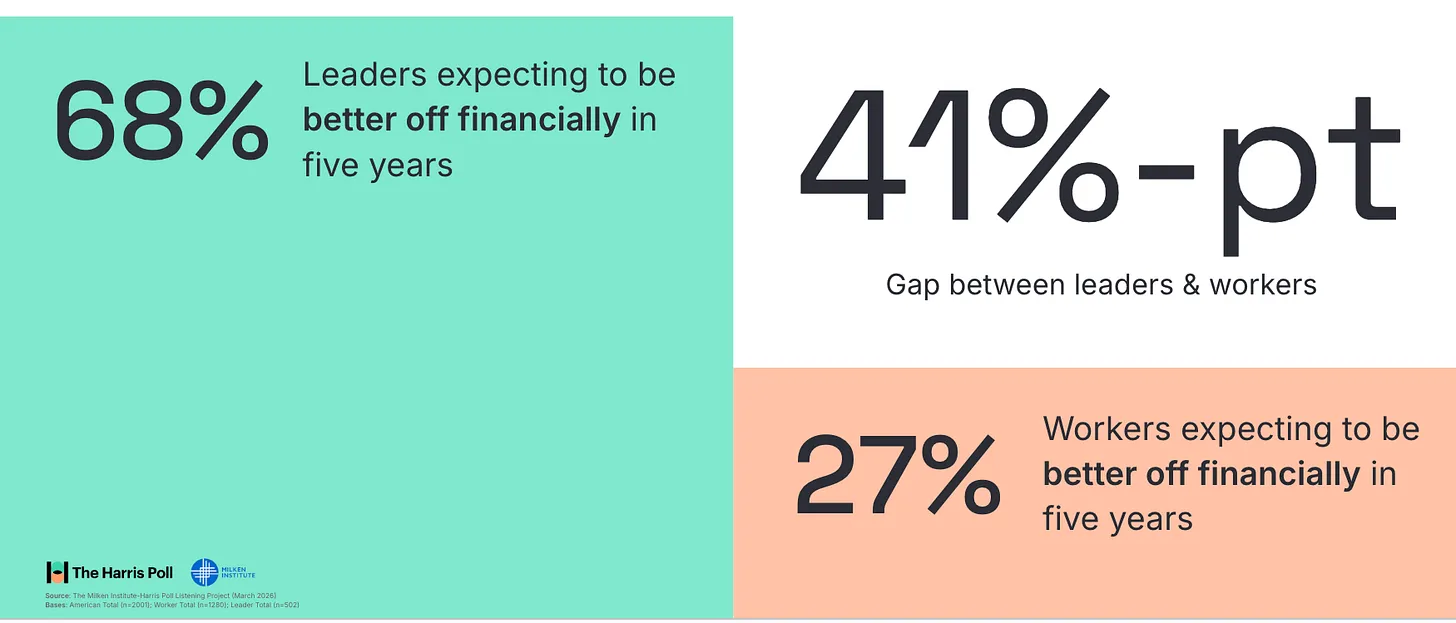
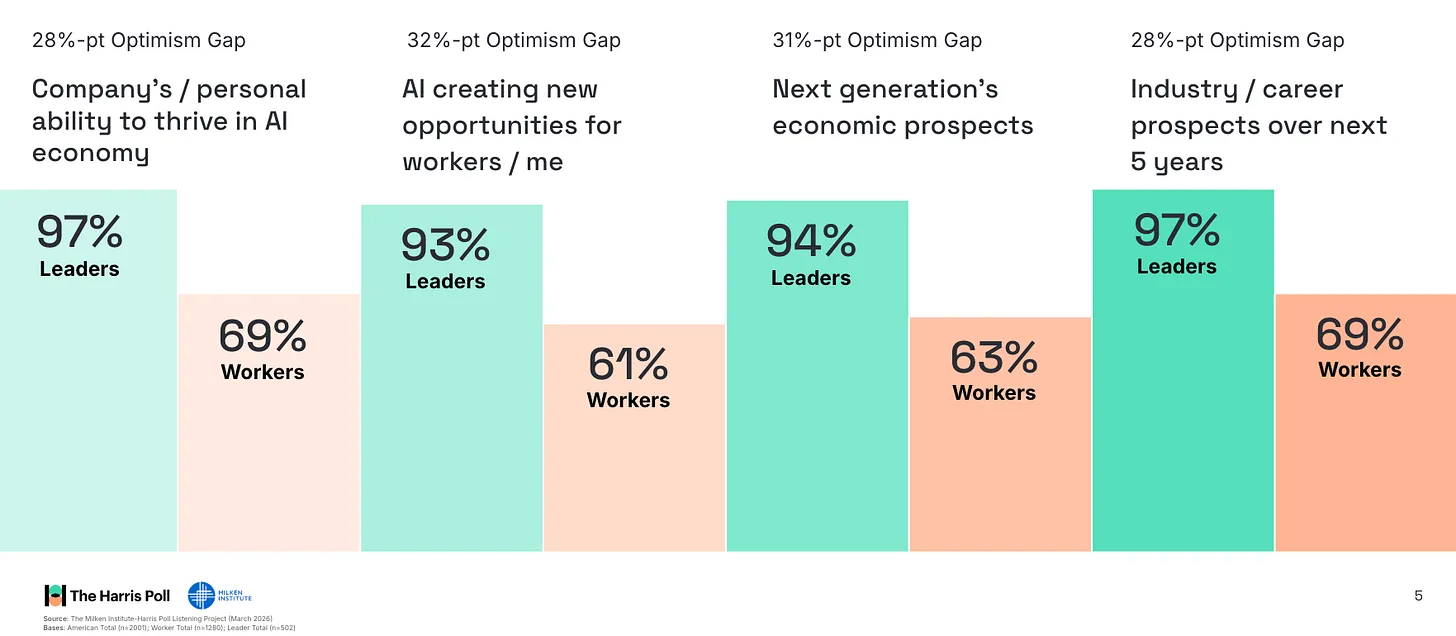
These are two distinct realities leading to a 41%-pt gap in expectations and clear optimism gaps for AI between leaders and workers. Yet there is room to build optimism if American workers are brought along in the transition rather than left in the dark. 61% say their leaders never discuss AI.
The Most Bipartisan Issue In America
In a time frequently driven by divisiveness, AI readiness has emerged as one of the most bipartisan issues. Over four in five Americans (83%) believe, “AI workforce readiness should transcend partisan politics.” In a country that rarely agrees on anything, this sentiment crosses party lines (Democrats 85%, Independents 83%, Republicans 82%).
It’s not just talk; they want action, too. Large majorities of both Democrats (84%) and Republicans/Independents (both 79%) think, “The government needs to start preparing workforce transition programs now for AI-fueled job displacement.”
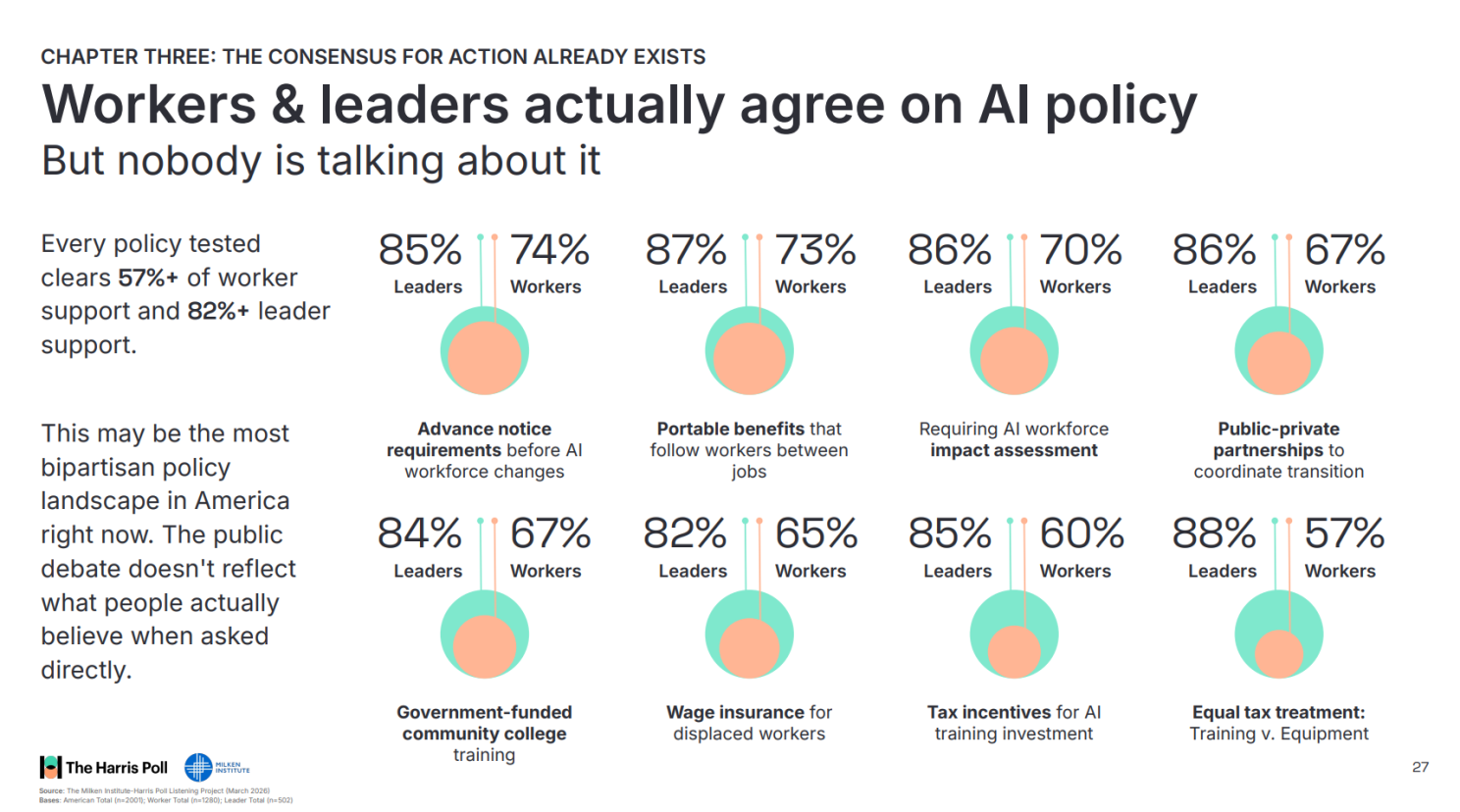
The agreement even stretches from the cubicle to the corner office. There was broad support across the many tested policies from both leaders and employees, such as government-funded community college transition and portable benefits that follow an employee from job to job. Every single policy cleared 57%+ support from workers and 82%+ from leaders.
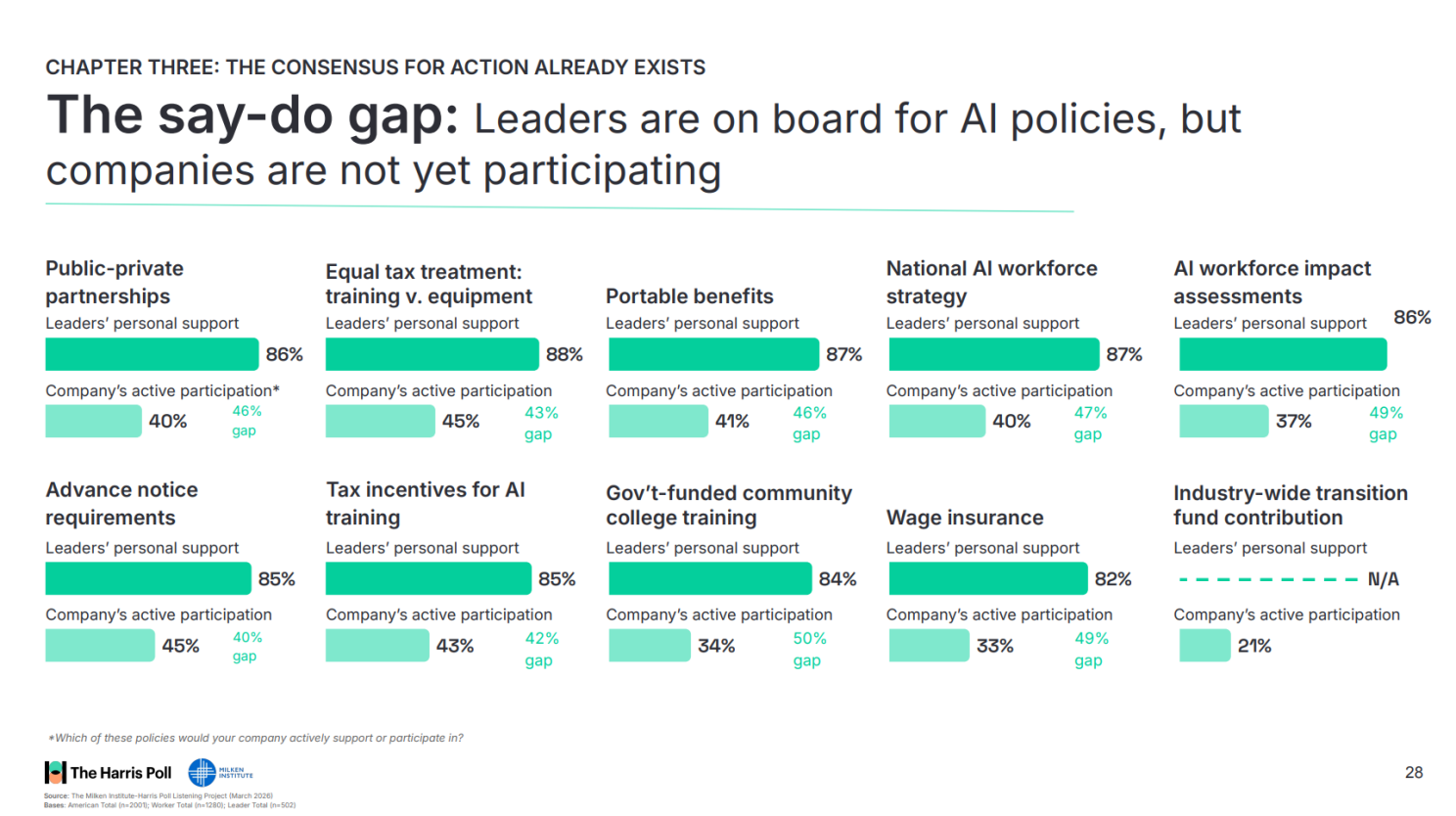
Yet there is a say-do gap: Leaders say they support AI policies, but their companies aren’t actually participating. While support for these policies ranged from 82% to 88%, the numbers cratered to 21% to 45% among companies that’ve put them in place.
The Window Won’t Stay Open For Long
Workers are anti-AI; they’re anti-abandonment. Over two-thirds still believe “AI can create more opportunities than it eliminates – if we get the approach right.” Business leaders and companies will have to be candid. The short-term narrative about efficiency-driven job loss is eating away at any long-term promise around AI. The bottom line is that the consensus exists, the window is open, but we’re missing the courage to move first.
As our CSO Libby said so perfectly, “The conviction is individual. The inaction is institutional. Without coordination, nobody moves first. The political will exists. The public urgency exists. What’s missing is the coordination infrastructure to translate consensus into action.”