

 5 Min Read
The latest trends in society and culture from The Harris Poll
Good morning from New York.
One Interesting Stat: 47. Could ChatGPT win a Booker Prize? Nearly half of Americans (47%) say they would read an AI-created book. Recently, Bookhub surveyed 1,200 authors and found that 45% are already using some form of generative AI.
We have four new stories from our polling this week:
- Gen Z brings some career fears into their criticism of AI in content creation.
- We explore the rise of “Living Room Families”, a novel concept where people gather together in the same room.
- More Gen Zers are embracing “career minimalism”, where a day job finances the side-hustle.
- Credit card stress is growing, even in high-income households.
AI’s Generation Gap
GenAI is reshaping how fans connect with the worlds and franchises they love the most. But Gen Z’s career fears make them more AI-critical as moviegoers.
- AI provides a new avenue for fandom: Half of Americans (49%) say AI tools will allow them to express their fandom in new ways, and 61% say fan-made AI content will be competing with official universe content.
- Caution – AI slop: Excessive or low-quality fan-made AI content could compromise the fan experience (73%).
- Especially when Gen Z isn’t a guaranteed fan: The top reason Gen Z has for hating brands using AI is the threat of replacing human jobs.
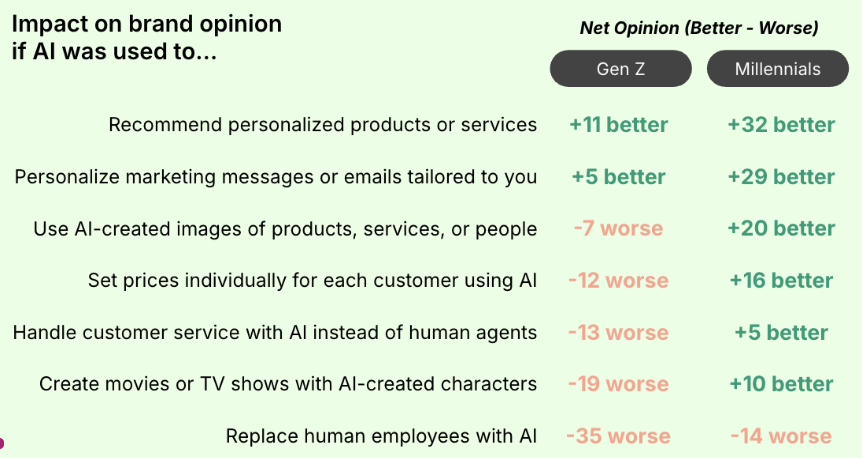
- Over half (53%) of Gen Z avoid brands that use AI in marketing, advertising, or other media (vs 36% of Millennials). Why are they adverse? The top reason: 37% are against AI being used this way due to its threat to replace human jobs (second to
Takeaway: From personalized fan immersion to expanded & always-active worlds to empowering new fan creators, genAI is providing new creative outlets for fans to engage with their favorite worlds. However, franchises beware, genAI could threaten brand safety and fandoms if it goes rogue with inappropriate content or fan fatigue.
Living Room Families: Preferred Travel Group-Harris Poll
“Living room families” – a viral term for families that hang out together at home (vs. alone in their rooms) – are becoming the new parenting ideal, and this mindset is going beyond the house.

- There’s a rise in multi-generational travel (and not just with young kids): (71%) of luxury travelers say they plan to take at least one multi-generational trip in the following year.
- They cite “creating shared memories” and “traditions” as primary motivators.
- There’s also an uptick in shared concert experiences, from dads showing up for Taylor Swift’s Eras Tour to Beyoncé’s Cowboy Carter release, which has become a family affair.
- This continues the IRL trend we’ve been reporting, where 81% would rather have an in-person social life than a digital-only one.
Takeaway: We’re seeing the “multigen-ification” of categories – consumers are turning personal moments into shared, family-centered experiences. For brands, it’s an opportunity to expand an audience and grow loyalty.
Generation Side Hustle: Fortune-Harris Poll
Instead of following in their parents’ footsteps, Gen Z is reshaping the definition of professional success, with many embracing “career minimalism” – treating day jobs as financial anchors while channeling ambition into side hustles and off-the-clock pursuits.
- America’s first true ‘side hustle’ generation: Over half of Gen Z (57%) have a side hustle (v. Boomers+: 21%).
- They are also the first generation for whom a 9-to-5 job isn’t essential for achieving financial success, turning instead to side hustles and investing, say over half of young professionals (51%).
- Not dreaming of the corner office: Glassdoor found that (68%) of Gen Z wouldn’t pursue management if it weren’t for the paycheck or title.
Takeaway: “We’ve traded the rigid career ladder for the career lily pad,” said Morgan Sanner, Glassdoor’s Gen Z career expert and founder of Resume Official. Side hustles aren’t viewed as distractions or fallback options; they are central to Gen Z’s identity, offering creative, entrepreneurial, or activist outlets that main jobs cannot supply. For many, the “day job” finances the “passion project”
Everyone’s Got Debt NFCC-Harris Poll
As credit card debt continues to rise, there are more signs that consumers — even those with higher incomes — are struggling to manage their balances, according to our poll with the National Foundation for Credit Counseling.
- Credit balances are getting tougher to pay: The share of individuals who paid off less than the required minimum on their credit cards rose to (13%) in August, from (8%) in the spring.
- Americans across income levels, from those earning less than $50k a year to over $100k, engaged in some “negative debt behaviors.”
- And compared to six months ago, (30%) of high-income earners are more concerned about having enough money to cover unexpected expenses, and (20%) making timely debt payments.
Takeaway: “It really doesn’t matter on the income level,” said Mike Croxson, CEO of the NFCC, an organization of non-profit credit counseling agencies. “It’s really about the debt level. Because when you reach the tipping point that the interest expense exceeds what you can afford to pay, that’s what gets the consumer into trouble.”