



 3 Min Read
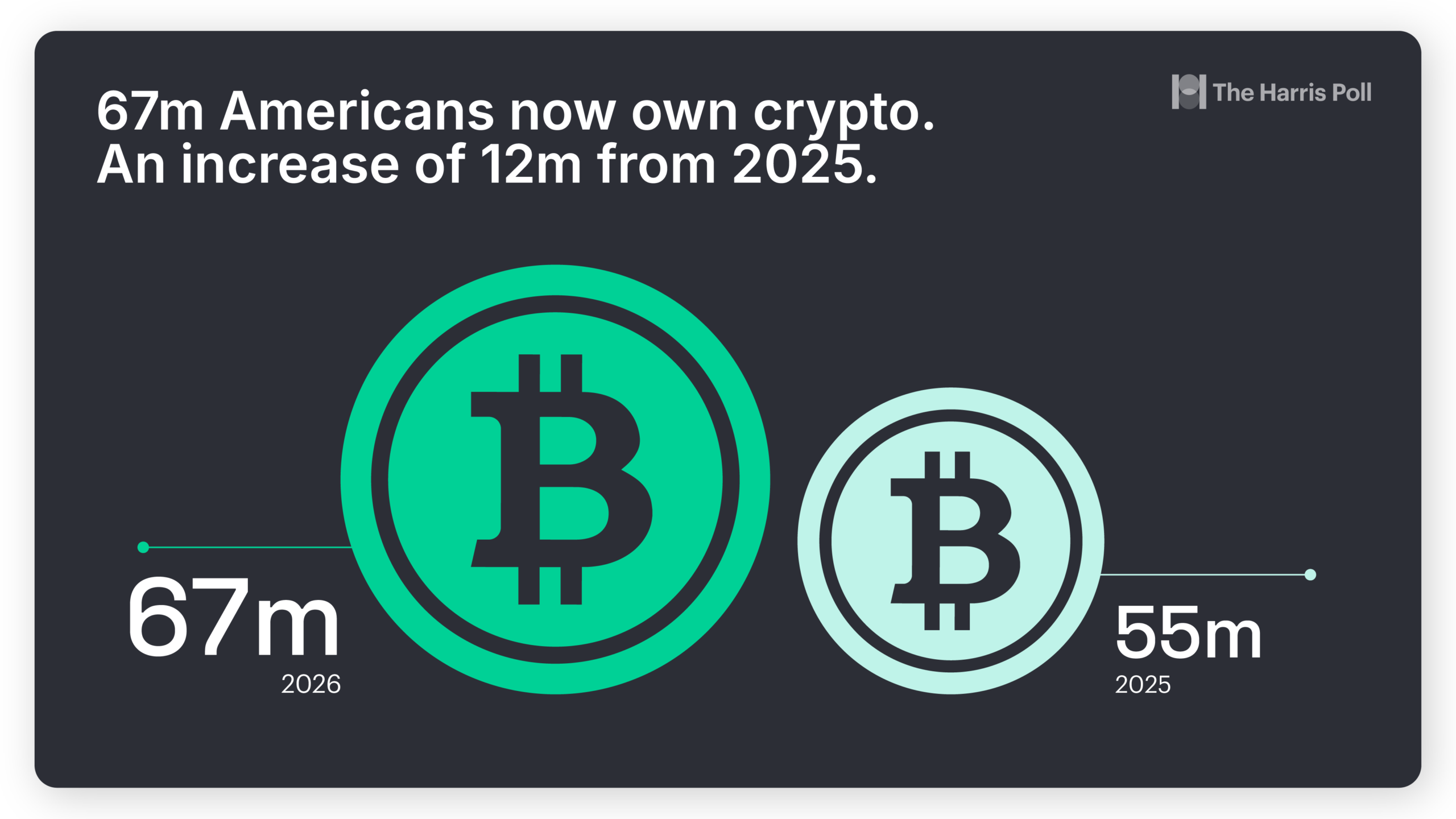
New data from the National Cryptocurrency Association (NCA), developed in partnership with The Harris Poll, shows crypto has moved into the mainstream. A quarter of American adults now hold digital assets.
That number marks a shift. What was once speculative now shapes how Americans invest, transact, and engage with money.
From curiosity to ownership
Crypto adoption followed a familiar path: there was the early hype, then doubt, then slow normalization.
However, ownership at this scale is a new phase. The holder base grew by 12 million people in a single year. When one in four adults participate, crypto stops being fringe and starts to becomes a mass-market asset class – one that institutions, brands, and policymakers need to understand.
Crypto is no longer a trend to watch. It’s a behavior to plan for.
The new holder breaks the stereotype
Forget the “crypto bro.” The 2026 data shows a far broader base.
Female ownership rose 10 points year-over-year. Among people who joined in 2025 and 2026, 42% are women – up from 34% of earlier adopters. The age range widened too, with more Gen Z, Gen X, Boomer, and Silent Generation holders than before.
Crypto is also no longer concentrated among the wealthy. Nearly 90% of holders earn under $500,000 a year, and almost a quarter earn $75,000 or less. Today’s holder is just as likely to work in construction or manufacturing as in tech or finance.
From speculation to everyday use
How people use crypto is changing too.
The most common uses are now practical. 41% of holders send crypto to friends and family, up from 31% the year before. Another 40% use it to shop for goods and services. More speculative activity is flat or falling: NFT use slipped from 32% to 30%.
Crypto is moving from a bet to a tool.
What this means for brands
Crypto holders are not one group. But they share a trait: they actively test new forms of value exchange. That mindset reaches well beyond finance.
So brands face new questions:
- Do we know how our audience uses emerging financial tools?
- Can we meet consumers in digital-first spaces?
- How do we show trust and transparency in a space still taking shape?
The bigger opportunity often isn’t “doing crypto.” It’s reading what crypto adoption signals about consumers – their openness to innovation, their appetite for risk, their expectations around control and ownership.
A moment for clarity
The NCA’s research gives a grounded view of where crypto adoption stands today. It cuts through speculation to show real behavior. For marketers and strategists, that’s the difference between chasing headlines and building relevance.
The useful question is no longer whether crypto will “take off.” It already has.
What comes next
At this level of adoption, the next phase shifts from awareness to integration.
As digital assets enter everyday financial life, attention moves to three things: usability, trust, and practical use cases.
For organizations that want to stay ahead, the priority is learning how real people use these tools now – and meeting their customers in that space.
About the research
The research was conducted online in the US by The Harris Poll on behalf of The National Cryptocurrency Association among 10,000 Cryptocurrency holders. The survey was conducted February 12 – March 3, 2026. The sampling precision of Harris online polls is measured by using a Bayesian credible interval. For this study, the sample data is accurate to within ± 0.7 percentage points using a 95% confidence level. This credible interval will be wider among subsets of the surveyed population of interest.