


 7 Min Read
Key takeaways
- You can’t build AI agents without governance first. The winning teams built the data foundation before deploying
- Trust is now a baseline expectation. Credibility and transparency drive purchase consideration in ways brand affinity alone doesn’t
- Creators perform best when brands give them creative freedom. Restricted briefs underperform
- Causal AI is emerging as the missing link between CMO and CFO conversations on marketing ROI
- The highest-value conversations happened off the agenda. Serendipity was engineered, and it worked
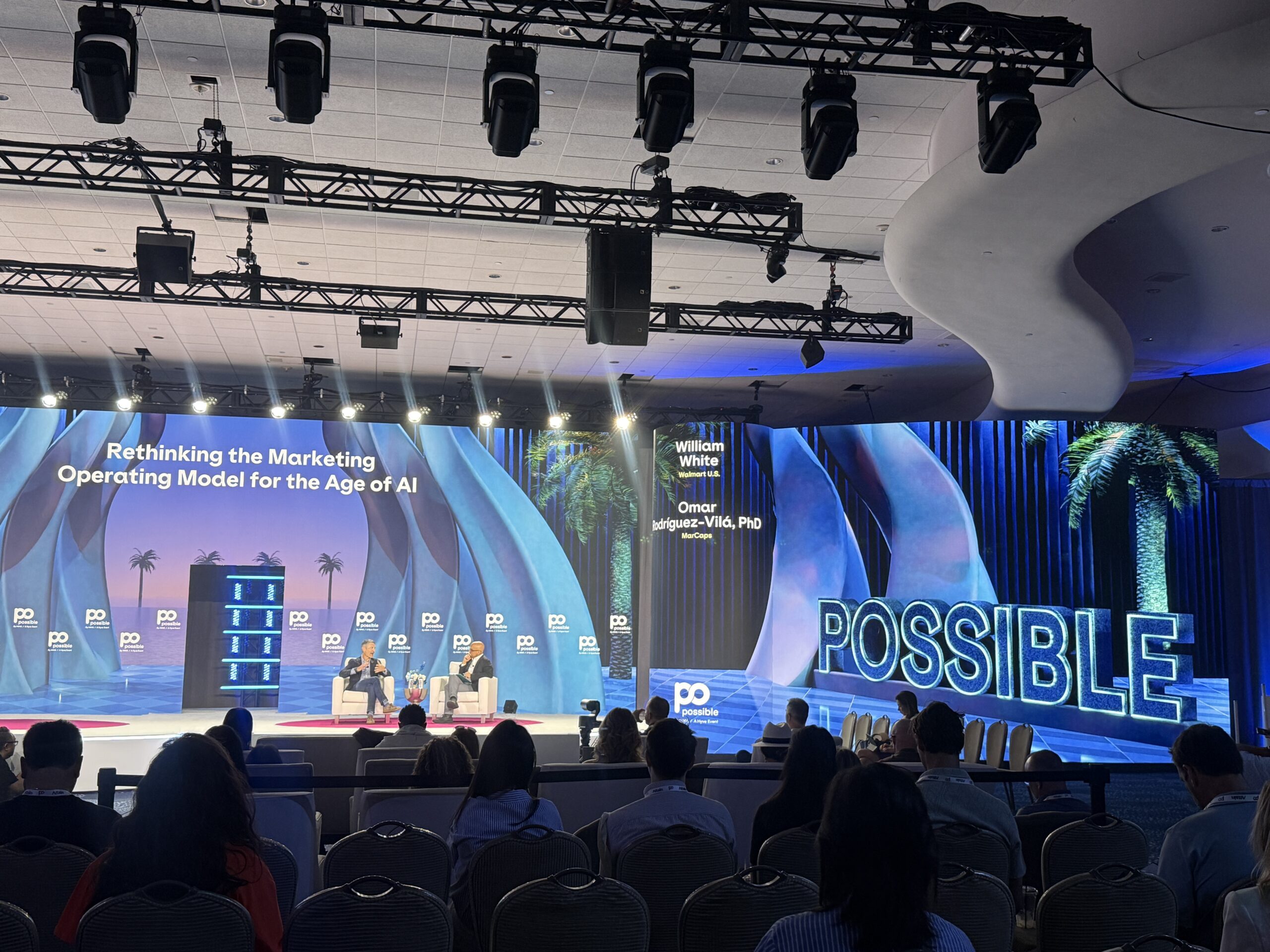
POSSIBLE has become the closest thing the U.S. marketing industry has to Cannes Lions Festival of Creativity. Roughly a third of attendees were brand-side decision-makers. 66% held VP-level titles or above, and representatives came from 44 countries. Our team was on the ground across sessions, panels, beach meetings, and the unscheduled conversations that often matter most.
Here is what we heard, and what it means.
Trust has become a growth driver
In an AI-saturated environment, credibility, transparency, and proof now drive purchase consideration in ways that brand affinity alone doesn’t. Brand safety remains critical – one memorable framing at POSSIBLE used SPF as a metaphor: just as sunscreen protects against invisible damage, brand safety protects against ad placements that erode trust without leaving an obvious trace.
Harris Poll data shows that nearly half of Americans blame corporations for rising costs – the same amount also blame the government. And only 12% of corporate reputations improved last year. In that environment, governed, transparent AI products have become the baseline expectation.
This is a challenge The Harris Poll has tracked for two decades. This month, we’ll release the 2026 Axios Harris Poll 100 – our annual ranking of the most visible company reputations in America, produced in partnership with Axios since 2019. It puts hard numbers on exactly what’s at stake when trust erodes, and why credibility can no longer be treated as a soft metric.
AI has moved from vision to execution, and the friction is showing
The AI conversation has moved from vision to execution, and the friction is showing.
Christie Bishop, SVP, Head of Tech & Entertainment clients at The Harris Poll, put it simply: “The conversation moved from ‘what can we build?’ to ‘why can’t we make this work at scale?'”
The answer, repeated across multiple independent sessions. AI’s limits are in messy or delayed data, disconnected systems, and teams that weren’t built to act on real-time signals. As Cox Automotive noted: “You cannot start building agents without governance.”
The winning teams built the data foundation first. Agentic AI is compressing build timelines from months to days in some cases, but only where that foundation supports it. Without it, AI optimizes a partial view of reality.
Our own research with Quad reinforces why governance matters: 75% of Americans say they would trust AI-driven shopping recommendations less if results were sponsored. The technology earns trust only when it’s governed well.
Measurement is quietly losing credibility
Underneath the AI conversation sits a harder problem: marketing still can’t prove its impact cleanly.
Finance doesn’t fully trust the numbers. Optimization is still built on proxies. The industry keeps reaching for the same partial answers – marketing mix modeling, multi-touch attribution – without resolving what both approaches miss.
Zeke Hughes, Managing Director of The Harris Poll and HarrisQuest, sees this as a structural problem. “Marketers are optimizing for signals that their own systems generated,” he says. “Syndicated, always-on data gives you the independent read – what’s actually moving brand equity, not just what your own stack is telling you.” HarrisQuest’s continuous tracking is built to close exactly that gap.
The terms that kept surfacing at POSSIBLE were pressure signals: incrementality, causal AI, real-time clarity. Each one attempts to answer the same question: what actually drove the outcome?
Causal AI emerged as what several speakers called the missing link between CMO and CFO conversations. When measurement can’t close the loop from data to decision to outcome, marketing’s seat at the business table gets smaller.
The creator economy has matured. Measurement hasn’t kept up
POSSIBLE 2026 formalized the creator economy as a dedicated track for the first time, bringing creators, platform leaders, and brand marketers together to examine how influencer-led marketing actually operates.
Creators are now central to media strategy. As Christie observed: “The brands getting it right aren’t ‘using’ creators. They’re building around them.” Nano and micro influencers are outperforming macro on authenticity and effectiveness. Creative freedom outperforms restricted briefs. Long-term ecosystems outperform one-off deals.
But measurement remains the industry’s biggest unresolved challenge. Creator supply is outpacing demand, spend is rising slower than the number of creators, and no clear ROI framework has emerged.
Harris Poll’s Return of Touch research helps explain why creators resonate right now: 81% of Gen Z say they wish they could disconnect more easily, making authentic, human-feeling content feel scarce and valuable. Creators who earn that trust – and are given the freedom to use it – are delivering what polished brand content no longer can.
The highest-value conversations happened off the agenda
POSSIBLE engineers serendipity: beach meetings, lobby corners, dinners, the unscheduled moments where real decisions get made.
Christie’s observation from Day 1 captured it well. At the ‘Our Third Place Women in Leadership’ brunch, a small pin given to every attendee carried a simple instruction: if you see someone standing alone, go up to them. This simple idea worked beautifully. “In a sea of thousands,” she said, “that small piece of metal might have been the most human thing I saw all day.”
Designing deliberately for human connection in an AI-saturated world is one of the things POSSIBLE gets right that most conferences don’t. A 15-minute face-to-face still achieves what weeks of back-and-forth cannot.
What the industry isn’t talking about, but should be
Creator measurement is broken and no solution was offered. AI’s diversity and bias implications were raised but not explored. Workforce readiness was almost entirely absent. And nobody defined what winning looks like in 12 months.
The industry is trying to run a real-time, AI-driven system on infrastructure that wasn’t built for it. Identifying the silence is part of reading the room.
POSSIBLE 2026 confirmed that the marketing industry is no longer debating AI – it’s struggling to operationalize it. The companies pulling ahead built the data foundation, governed the systems, and kept humans in the loop where it counts.
We’ll be taking these conversations to Cannes Lions. If you’re heading to SPORT BEACH, request some time with our team to chat.