


 10 Min Read
The 2025 World Series pitting the Los Angeles Dodgers against the Toronto Blue Jays has been hailed by commentators as one of the greatest of all time. Coming off a disappointing 2024 season in which they missed the postseason, the Blue Jays’ underdog run captured the imagination of Canada, especially amidst a tense moment in Canada-U.S. relations. Game 7 is estimated to have been viewed by almost a quarter of the country’s population, making it the fourth most watched television broadcast in Canadian history. This achievement is enhanced by the fact that, historically, baseball has not been a particularly popular sport in Canada: in 2005, it was the 6th most practiced sport in the country, and it was the fourth most followed sport as of 2023. Its fandom has also skewed older and whiter compared to rising sports like basketball and soccer. The Blue Jays’ historic season therefore has the potential to reinvigorate baseball’s popularity in Canada, both in terms of active participation and in interest in the MLB.
A few months later, the United States captured both the women’s and men’s Olympic gold medals in ice hockey. While the U.S. has historically excelled at women’s hockey, winning two of the three most recent Olympic tournaments, it was the men’s first gold medal since the Miracle on Ice of 1980. Those victories, combined with cultural forces such as the creation of the Professional Women’s Hockey League and the success of the sport romance Heated Rivalry, have boosted hockey’s visibility in America. As of 2025, it remained the least popular of the “big four” sports in the US, with some 17% of Americans reporting watching NHL hockey games. Even with ongoing efforts to push the sport into the South and West, ice hockey continues to be rooted primarily in northern and Midwestern states. Minnesota, the hub of American hockey culture, has almost twice as many registered players as California despite having a population six times smaller.
We extracted social media data from the last year to attempt to understand if there are any changes in baseball and ice hockey’s popularity in Canada and the U.S. respectively. Our sample specifically excluded news articles to capture organic, user-generated content. We considered three metrics: sentiment (the tone of the posts; either positive, negative, or neutral), volume (the number of posts), and engagement (the number of interactions posts received). The results were indexed for the other country to isolate any national uptick in popularity from wider trends.
Baseball
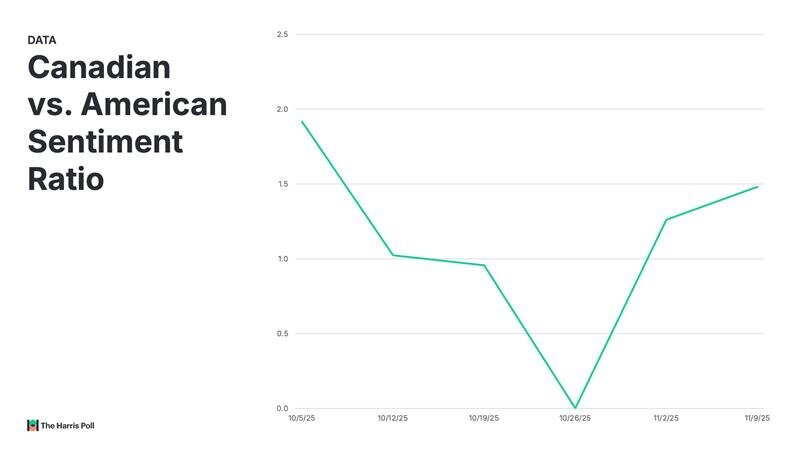
In both Canada and the U.S., content about baseball tended to skew positive. Social media users typically celebrate their teams, both through victory and defeat, and speak about baseball with excitement. While American posts tend to be slightly more positive than Canadian ones, the ratio of sentiment between the two country is roughly equal to one and has remained as such since the fall of 2025. Nevertheless, some outliers in Canadian sentiment were observed during the post-season, notably a spike in positivity during the week of October 5th (when the Blue Jays defeated the New York Yankees), followed by a significant dip during the week of October 26th (when the Blue Jays lost the World Series to the Dodgers). But the data suggests that the tone with which social media users communicate has not meaningfully changed.
The volume of posts mentioning baseball tells a more interesting story. Despite Canada’s population being roughly a tenth of the U.S.’s, American accounts contributed 94% of posts in the sample, reflecting the higher popularity of the sport south of the border. However, there has been an uptick in Canadian posts since the start of the post-season that had not meaningfully subsided entering in 2026. Between February and August 2025, 4% of sampled posts originated from Canada; that ratio has climbed to 9% for the period between September 2025 and February 2026. The end of the year notably brought about a flurry of posts reminiscing on Toronto’s performance, suggesting a renewed emotional engagement with baseball that had not wanned two months after the season ended.
“Thank you, Blue Jays…as a fan since first pitch in the snow at the Ex in 1977 to today, I will not soon forget what magic this 2025 season to all of CA…each and every one of you made this a season to always remember…onwards to 2026!!! @BlueJays
– @skigril1965 on X, Nov 2 2025
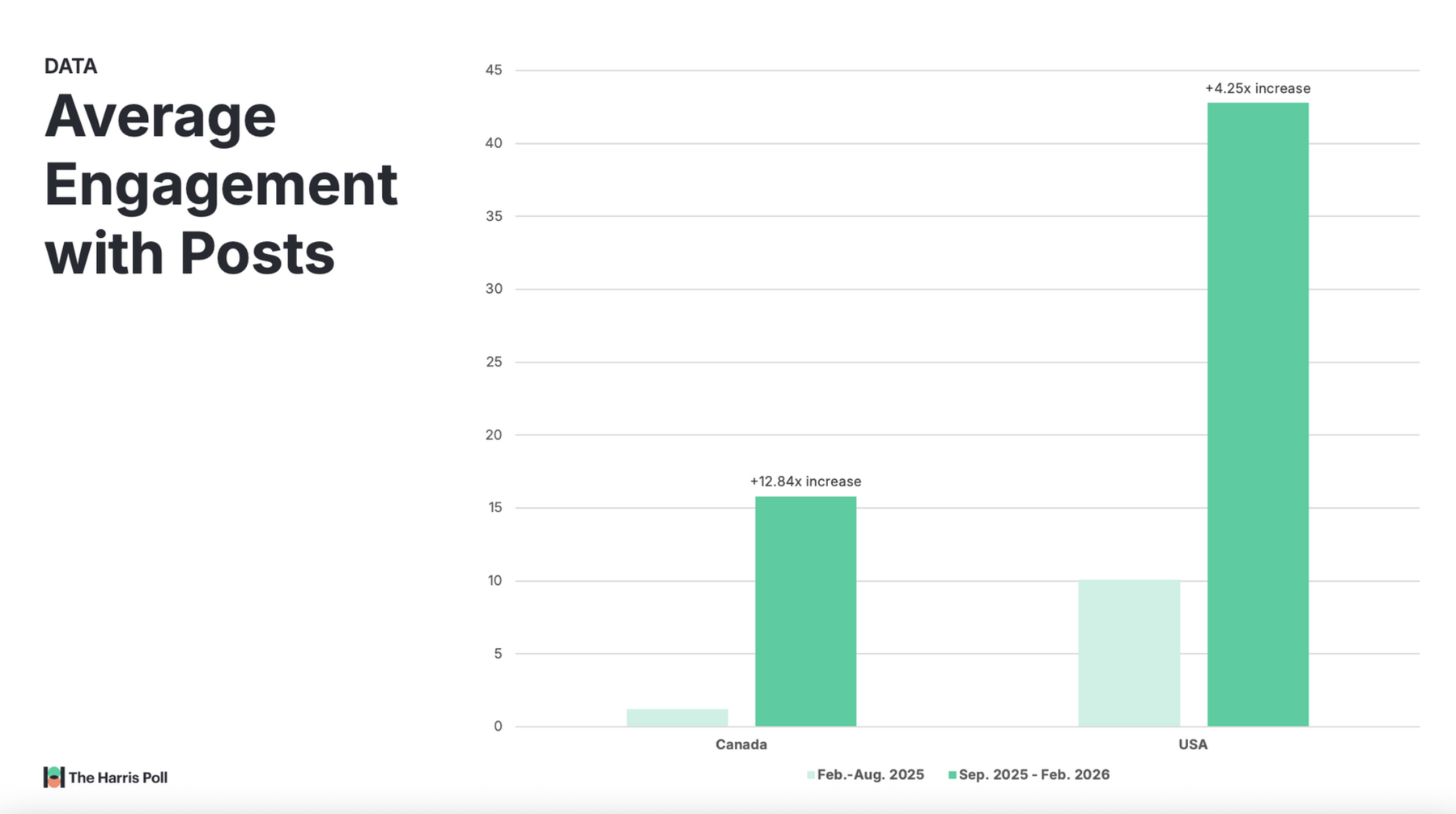
Complimentarily, over the same period, there has been a significant uptick in engagement with Canadian posts. Between February an August 2025, Canadian content averaged 1.23 interactions, compared to 9.00 during the post-season period of September and October. While engagement has been growing in both countries, since September 2026, the amount of engagement with Canadian posts has increased almost 13-fold, compared to a fourfold increase in the U.S.
Hockey
“Hockey is a rich family sport, hockey registration is down 30%, rinks are not being built less and less Canadians are playing hockey vs USA where hockey is booming, USA hockey has great programs and many college/university teams”
–@Forsberg2121 on X, Feb 19 2026
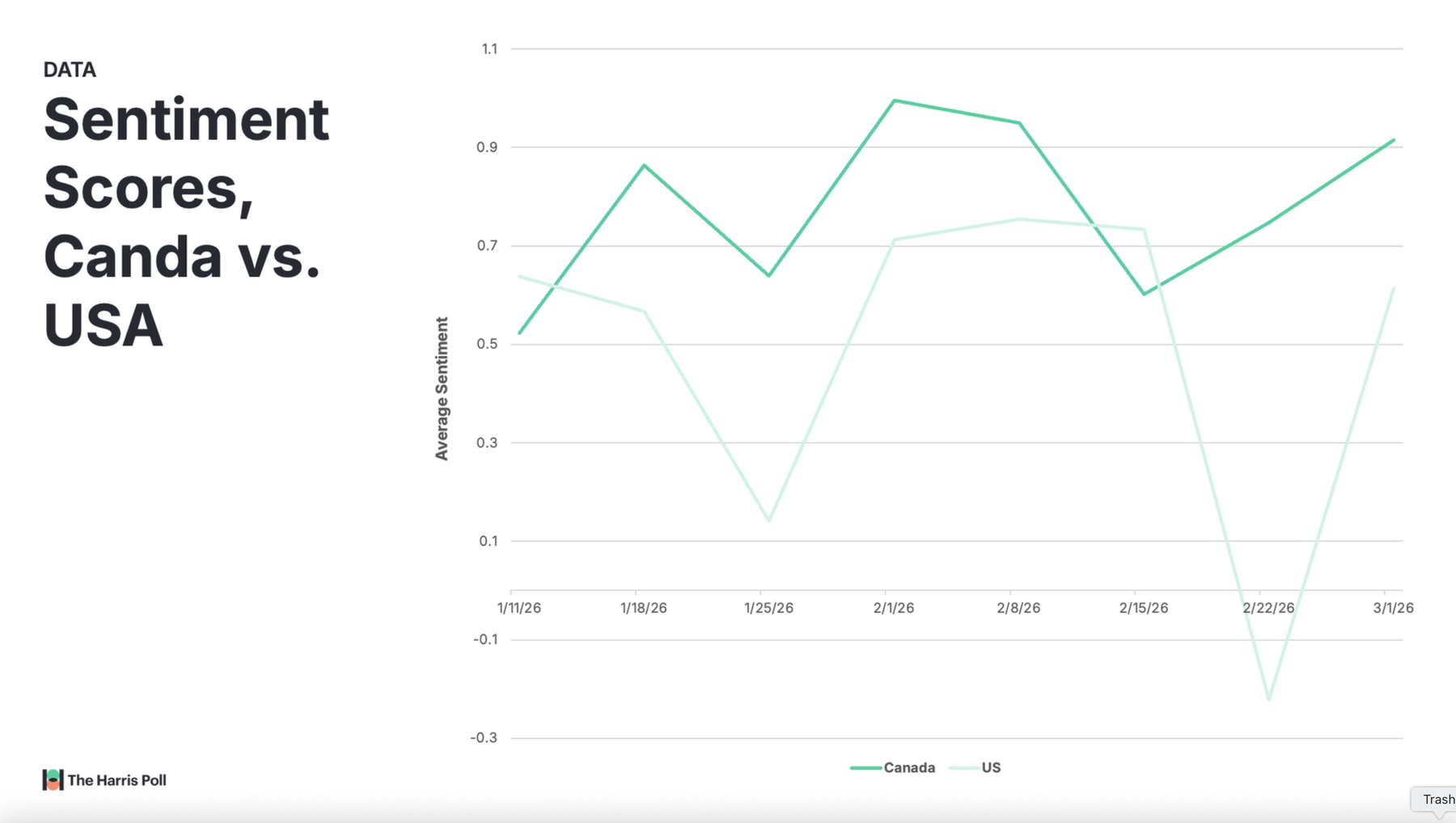
Similarly to baseball, posts about ice hockey were generally positive in Canada and the U.S, with the Canadians being more optimistic than their American counterparts. Interestingly, in both countries, the average sentiment dropped during the final two weeks of the Olympic tournament: a survey of posts from that period reveal that bickering between Canadian and American fans drove down the typically positive nature of messages.
“Youth registration surpassed Canada for Hockey in the USA 2022 and hasn’t looked back. You are now training less people than the USA. The guys that just won the gold had close to 1/4th registered in the USA as today. Now you are behind the USA. Its over, its over forever. You are England in Soccer now”
–@CochraneChris on X, Feb 24 2026
Sentiment was lower in Canada than in the U.S. during the week of February 15th, when the U.S. women’s team won. Indeed, in both countries, the women’s tournament was generally well received. However, counterintuitively, the trend flipped in the following week during the men’s final, with Americans being more negative. In fact, in the week of February 22nd, content from the U.S. was more unfavorable than positive, leading to a negative sentiment score. That said, a significant number of posts were political in nature and unrelated to hockey itself. As of the week of March 1st 2026, the sentiment of posts had returned to baseline in Canada but remained comparatively lower in the states.
Hockey discourse on social media, while being mostly American-based, is overrepresented by Canadian accounts. Some 17% of all posts in the sample originated from Canada, or twice what would be expected based on population alone. However, the data suggests that the Olympic tournament attracted the attention of Americans, who posted and engaged with content more than usual during the second half of February. But as of the week of March 1st 2026, the proportions were back to their pre-Olympic levels, despite the ongoing NHL season. This would suggest that the gold medal performances were not enough to drive Americans to engage with hockey social media. The sentiment analysis suggested that the fallout of the men’s tournament got a mixed reception from Americans, which matters in a context where the overwhelming majority of hockey social discourse relates to the NHL and male players.
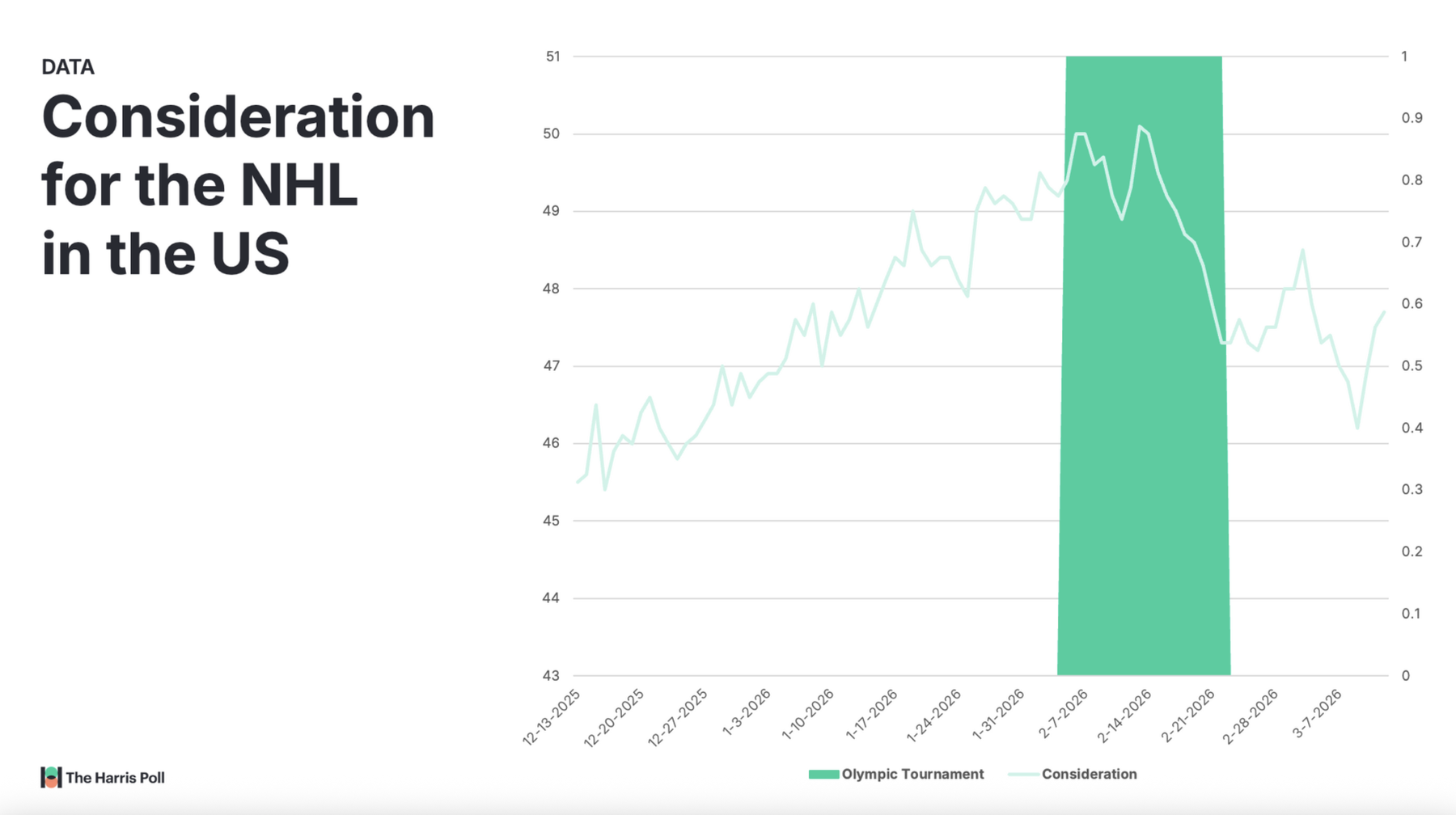
Beyond social media data, the Harris Poll collects daily impressions for the NHL in the U.S. through the Questbrand platform. Questbrand is The Harris Poll’s industry-leading brand tracking platform that tracks consumer sentiment and perceptions. The data is collected daily, provided a real-time snapshot of emerging trends. While consideration for engaging with the league had been steadily going up after the start of the NHL season in October, this metric plateaued in early February, and started a small downward dip around the dates of the Olympic tournament finals. Similarly, momentum (defined as whether the brand is heading in the right direction) has been flat since the start of 2026. The trends are generally identically across gender lines. While it is too early to derive any meaningful long-term trend, we can conclude that, in the short term, the US’ Olympic performance did not translate in an increased interest in the league.
Conclusion
All in all, analysis of social media data gives credence to the idea that the Blue Jays’ 2025 performance has, at least temporarily, helped boost the visibility of baseball to a Canadian audience. Compared to their American peers, Canadians have increased their participation in baseball social discourse and are engaging with posts more often. This jolt in popularity presents an opportunity to the MLB, who is planning to add two new teams to its league in the coming years. The Blue Jays’ de facto role as “Canada’s team” gives it the largest home market in the MLB, and baseball’s growing popularity, particularly among a younger and more diverse audience, shows there would be an appetite for the return of the Montreal Expos or the creation of a new team elsewhere in the country.
“ICYMI: “The success of the @BlueJays tends to spark interest in baseball across Canada. The fanbase grows and more eyeballs turn to the game, while registration in youth baseball and softball also receive a boost” #WANTITALL #WorldSeries”
–@ABDugoutStories on X, Nov 4, 2025
The impact of the Olympic tournament on ice hockey in the United States, meanwhile, is more mixed. Social media analytics and survey data collected on Questbrand suggest the U.S. national teams’ performances had no meaningful impact in driving interest in ice hockey in the U.S. Per QuestBrand, familiarity with the NHL in the United States is already in the 80% range, suggesting the potential fan base is already nearing its ceiling. The Olympic tournament was also one of many events that caught the attention of Americans in Milan, in addition to happening a few days after Super Bowl LX. In this crowded environment, gold medals in a sport that interests a limited number of Americans were not sufficient to attract new attention to the sport. The U.S. National Teams also could not commandeer organic patriotic sentiment the same way the Blue Jays did. A few posts from our sample, however, suggest a silver lining: the Olympics tournament is a rare prime time showcase of women’s sports, and the USWNT’s win opened the door to new generation of girls to see a place for themselves on the ice.