


 8 Min Read
ChatGPT is a phenomenon. Not just an AI breakthrough — a brand phenomenon. And QuestBrand now measures it in 21 countries worldwide.
In the U.S., my relationship with it evolved fast. First, it was my writing partner — sharpening memos, rewriting decks, and turning half-baked thoughts into something you’d actually want to say in a meeting. Then it followed me out of the office.
It translated menus. It answered absurd questions. One day I asked: “If you were human, what would your name be?” Without missing a beat: “I think I’d be a Miles. Feels like a name you could grab coffee with.”
That’s when it hit me — the most striking thing wasn’t scale; it was the humanity.
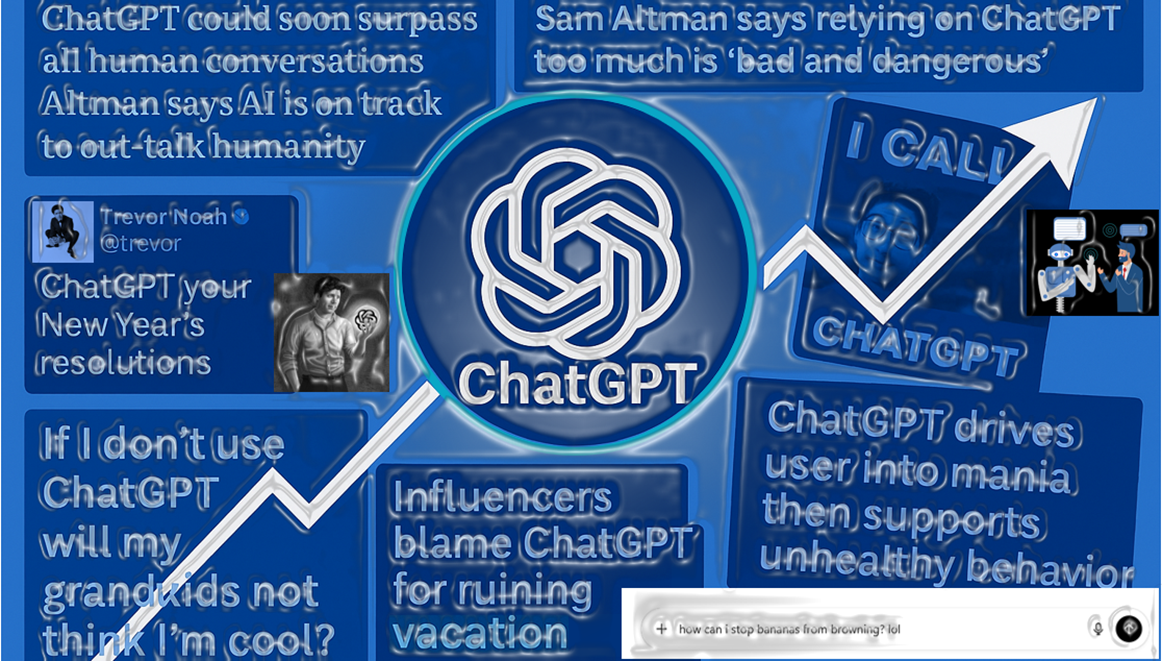
Because the interface is so quick and natural, it feels like slipping back into an AIM chat window after school — only this time, your buddy is an AI. One afternoon, my fiancée glanced over my shoulder as I asked ChatGPT how to keep bananas from browning. Then she saw me type “lol” and asked why. The answer was simple: because it’s Miles.
That’s the magic of the conversational interface: it makes the everyday feel personal. And once you’ve had that experience, it stops feeling like software. Which explains why its awareness curve isn’t just steep — it’s vertical.
Awareness at Warp Speed
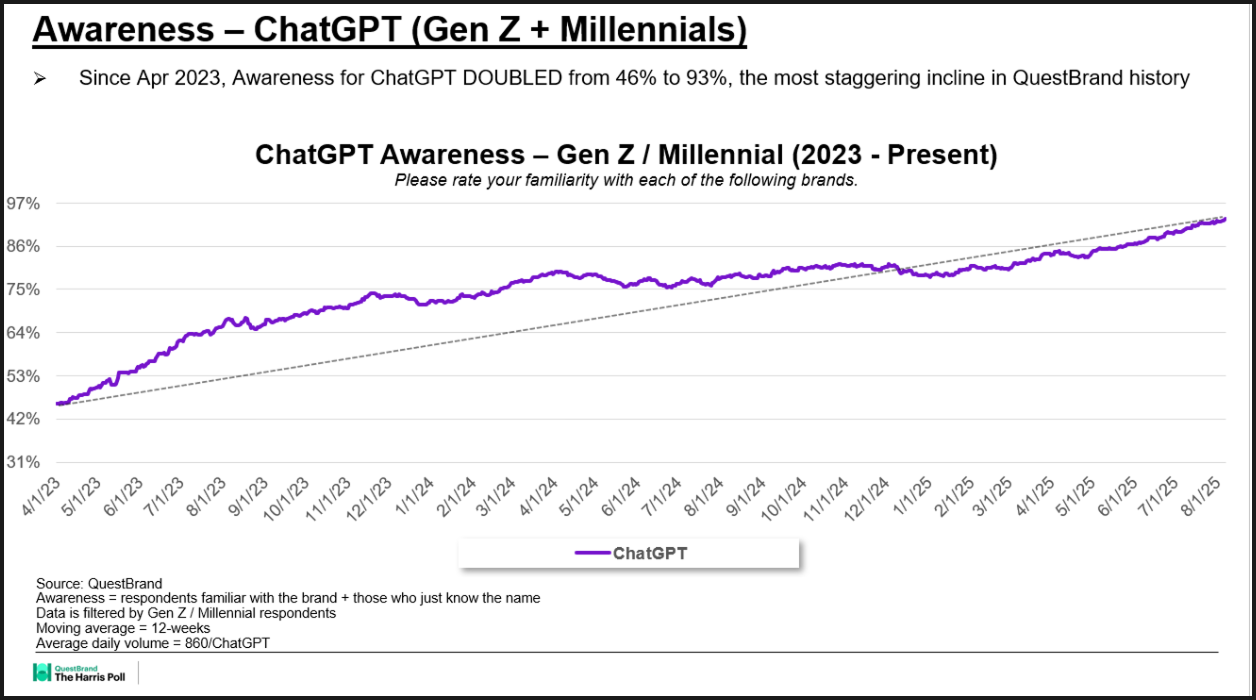
In 15 years of tracking brands, I’ve never seen a trajectory like this. Since April 2023, U.S. awareness of ChatGPT among Gen Z and Millennials has doubled — from 46% to 93%. Seeing that number jump on our QuestBrand charts was one of those stop and stare moments:
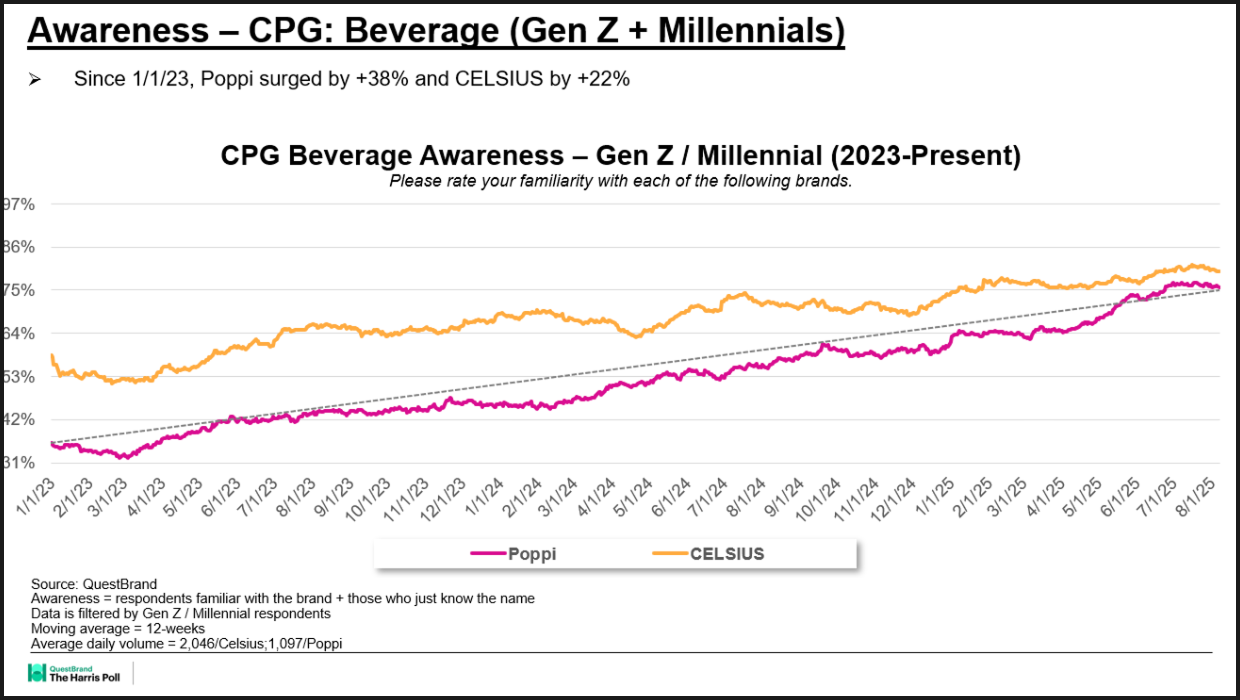
Even the fastest-growing brands in other high-momentum categories can’t match ChatGPT’s Awareness curve. In beverages, Poppi and Celsius have surged— but their lines still look like gentle hills next to ChatGPT’s vertical climb.
The same goes for Coinbase, despite the ever-rising popularity of cryptocurrency, especially among Gen Z/Millennial consumers:
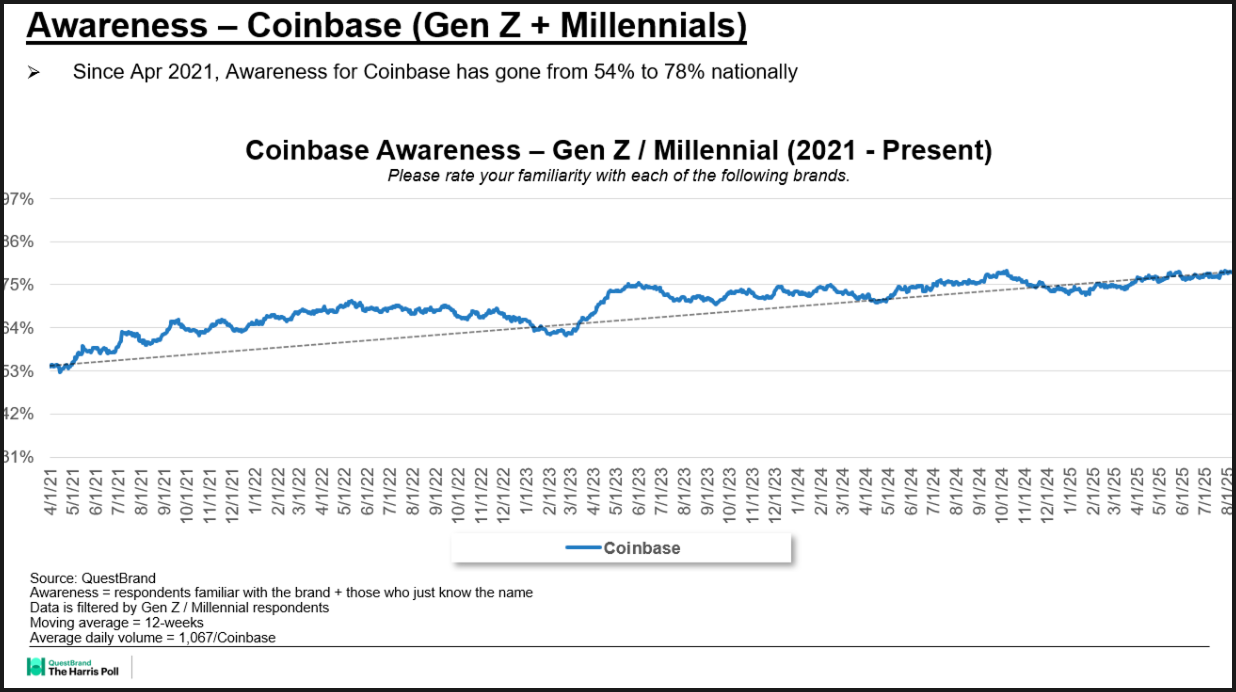
These are brands with cultural visibility, social virality, and substantial marketing budgets. ChatGPT has none of that. It’s scaling on utility, word of mouth, and cultural shorthand alone.
From Early Adopters to the Masses
With Gen Z and Millennial awareness already near the ceiling, ChatGPT’s next wave of growth will come from ambient resonance — when the cultural habits of one group slowly bleed into the daily lives of others.
You don’t have to use ChatGPT yourself to see its influence. You hear it mentioned in meetings, see it in headlines, watch it referenced in TV scripts and TikToks. Over time, that constant exposure normalizes the brand and lowers the barrier for people who weren’t actively seeking it out.
We’ve seen this play out before. Take TikTok between March 2021 and December 2022. By March 2021, Gen Z and Millennials had already reached peak awareness — hovering around 90% and plateauing. But look what happened next:
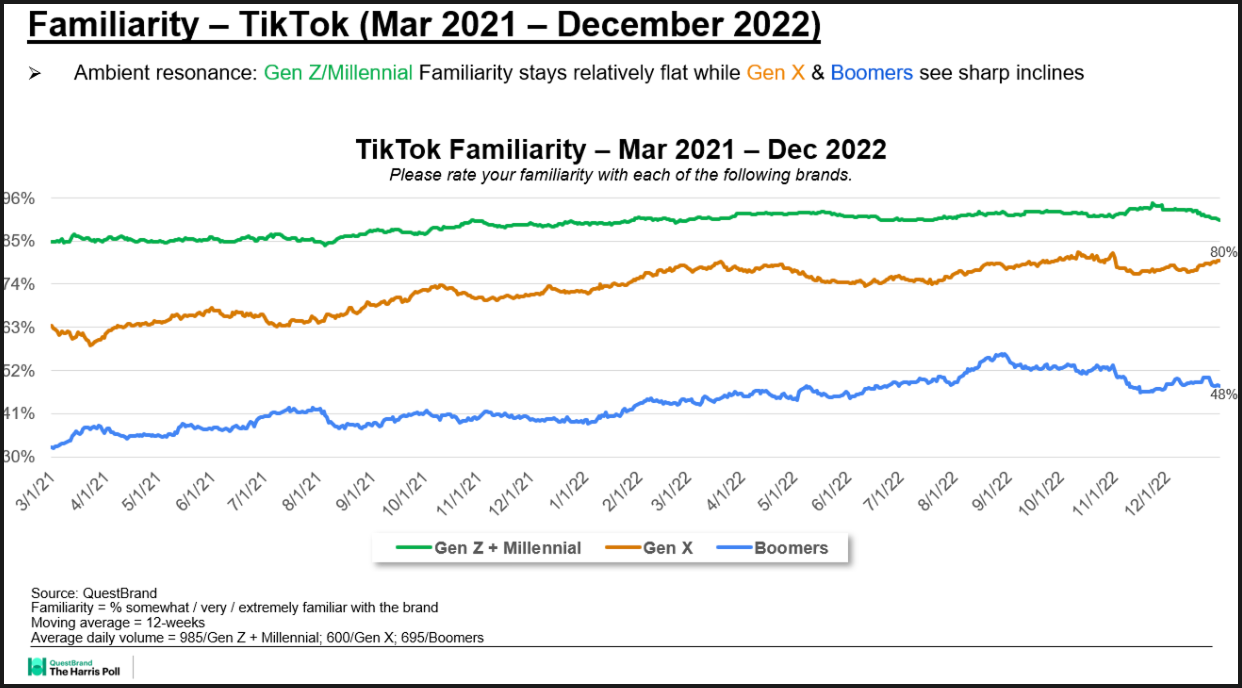
- Gen X familiarity jumped from ~60% to ~80%.
- Boomers rose from ~30% to ~50%.
The younger cohort’s awareness didn’t need to keep growing; their cultural output did the work. As their use of the platform became embedded in pop culture, older generations closed the gap.
For ChatGPT, the pattern will likely be similar. The opportunity lies in translating its utility for:
- Gen X – many know the name but haven’t used it directly.
- Boomers – an even larger untapped audience, especially for professional, hobbyist, and accessibility use cases.
The brand’s challenge is clear: expand without losing the agility and personality that made it explode in the first place.
Beyond the Honeymoon
In brand tracking, Momentum measures the difference between people who think a brand is “on the way up” versus “on the way down.” It’s where you can see the effect of the “shiny new thing” in real time.
When something bursts into the cultural spotlight, Momentum often spikes early. People are curious, optimistic, and projecting growth. But as novelty fades, that curve inevitably comes down — even if awareness and usage remain high.
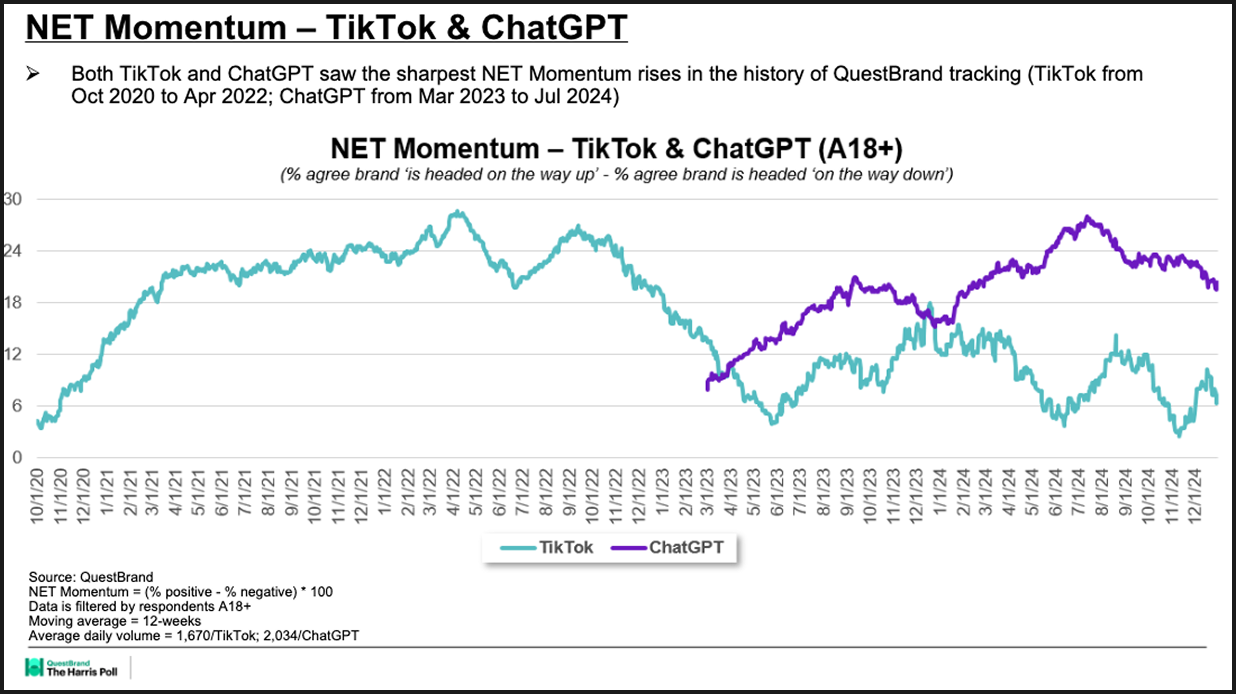
TikTok’s early Momentum surge flattened as the platform matured and debates over moderation, regulation, and competition took hold. ChatGPT (purple line) is still in its peak phase — perception is overwhelmingly positive.
The question isn’t if the glow will fade — it’s when. And when it does, the brands that hold their ground are the ones that have invested in long-term Equity: deeper trust, quality, and consideration scores that survive past the honeymoon stage.
Peloton shows what happens when a brand rides novelty without building that foundation. Its pandemic-era halo collapsed when quality issues and shifting market conditions hit, driving momentum — and customer loyalty — into freefall.
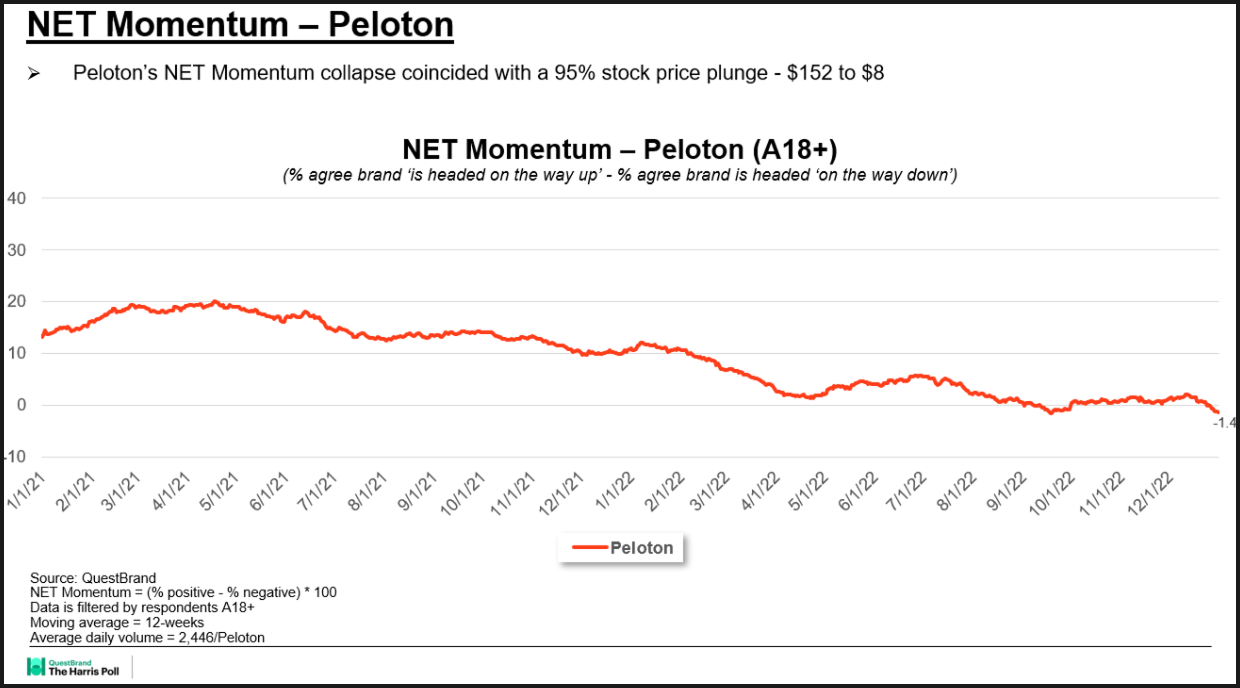
The lesson is simple: novelty creates a spike, but equity keeps you standing when the bubble bursts. Peloton didn’t have the depth of trust, quality, and consideration to weather the fall — and those are exactly the pillars ChatGPT will need if it wants to stay indispensable once the shine fades.
Fame is Fast, Endurance is Earned
Some brands handle the post-honeymoon phase flawlessly. Apple has turned product launches into cultural events for over a decade. Nike blends innovation with consistent brand values. Netflix has weathered disruption after disruption without losing its core audience. These are brands that invested in Quality, Trust, and Consideration long before their novelty wore off.
Others… not so much. MySpace once ruled social networking, woven into pop culture and daily life. But without innovation — or a foundation of trust and quality — it was overtaken by Facebook, its cultural relevance evaporating almost overnight. Today it’s little more than a nostalgic punchline in internet history (sorry, Tom).
Tesla’s equity story is messier. Still viewed as highly innovative (per QuestBrand), it suffers from volatility tied to product concerns and public controversies.
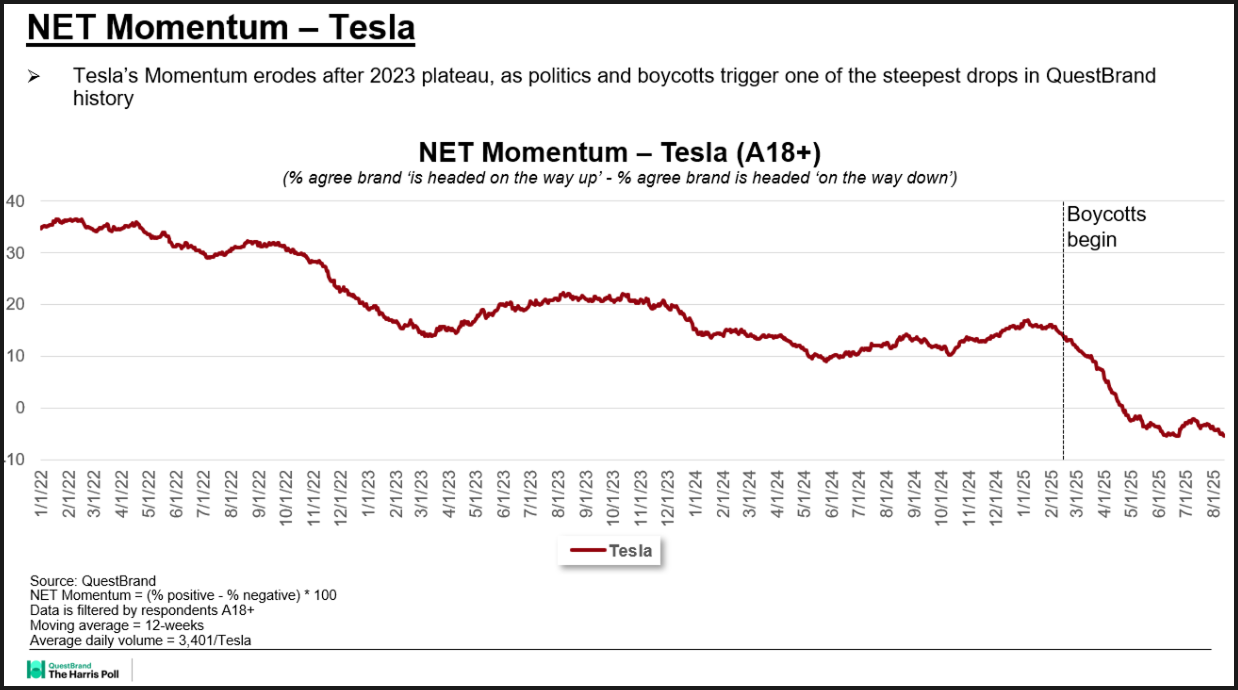
Elon Musk famously eschews traditional brand-building — skipping market research, downplaying advertising, and betting almost entirely on vision and engineering. That works while Tesla’s tech lead is wide, but it’s a risky wager. Musk has a track record of alienating core audiences, and national brand loyalty is thinner than its market cap implies. A catastrophic crisis — from a high-profile FSD disaster to a mass safety recall — could drain what goodwill remains, leaving Tesla exposed. In that vacuum, rivals with comparable tech could seize the lead, proving that innovation alone can’t secure a generational brand.
For OpenAI, the lesson is clear: even with the smartest people on the planet keeping your product ahead of the curve, equity is the moat. Apple has one. Amazon has one. Costco has one. It’s the intangible foundation that powers loyalty, premium pricing, and resilience when competitors catch up. Without it, even market leaders can be overtaken the moment their edge fades.
The Stakes of the Next Chapter
The leap from phenomenon to generational brand isn’t automatic — it’s earned through trust, quality, relevance, and credibility.
As the first AI product to achieve mass cultural adoption, ChatGPT has what scholars call a first-mover advantage — defining the category in consumers’ minds before competitors arrive. But that edge lasts only if the story stays consistent. For OpenAI, the most critical launch in the coming years won’t be GPT-6 or GPT-7 — it will be their first major advertising campaign. The next step is making sure ChatGPT’s image in culture matches the brand OpenAI wants to build. Millions use the name as a verb — and many don’t even know what “GPT” stands for. That’s both proof of ubiquity and a warning: cultural shorthand can outpace corporate narrative.
ChatGPT’s next chapter will bring storms — some sudden, others slow-moving — all testing whether its brand can endure. A viral accuracy failure could erode trust. A rocky rollout, like the recent GPT-5 debut covered by CNN, can spark backlash. Rivals like Google Gemini, Anthropic’s Claude, or an unknown challenger could match its fluency and erase the novelty edge. Regulation could limit capabilities or reshape marketing. Ethical flashpoints — bias, misuse, disinformation — could ignite a crisis overnight. And cultural fatigue may be just as dangerous: Just ChatGPT it loses power if innovation stalls.
The stakes are already visible. The New York Times has reported cases of users convinced the AI was sending personal messages, influencing life decisions, or channeling metaphysical entities. Other outlets have covered “chatbot psychosis,” where dependency spiraled into paranoia or self-destructive behavior. These aren’t PR flare-ups; they’re equity risks.
The playbook is clear: protect the trust advantage with stronger safeguards; maintain quality as usage scales; grow equity beyond Gen Z and Millennials to win Gen X and Boomers; and lead with credibility from the very top.
QuestBrand has seen this arc before. MySpace, Peloton, and others enjoyed extraordinary surges before turbulence they weren’t prepared for. The brands that endure keep building their foundation long before the tide turns. ChatGPT’s awareness curve is the steepest we’ve ever tracked — but curves are just lines. The real race is turning this one into a foundation strong enough to hold when everyone else catches up. Because, as Warren Buffett famously put it: “It takes 20 years to build a reputation and five minutes to ruin it.”