



 3 Min Read
Canadians continue to embrace the holiday meal as an important seasonal tradition, but the way they approach holiday foods and cooking is shifting in meaningful ways. While the more common dishes remain central to celebrations, many, especially younger generations, are increasingly open to moving away from the classic menu. At the same time, the demands of holiday meal preparation generate notable frustration, with clear generational divides shaping attitudes around effort, tradition, and convenience.
Traditional holiday foods are enjoyed but not universally viewed as essential
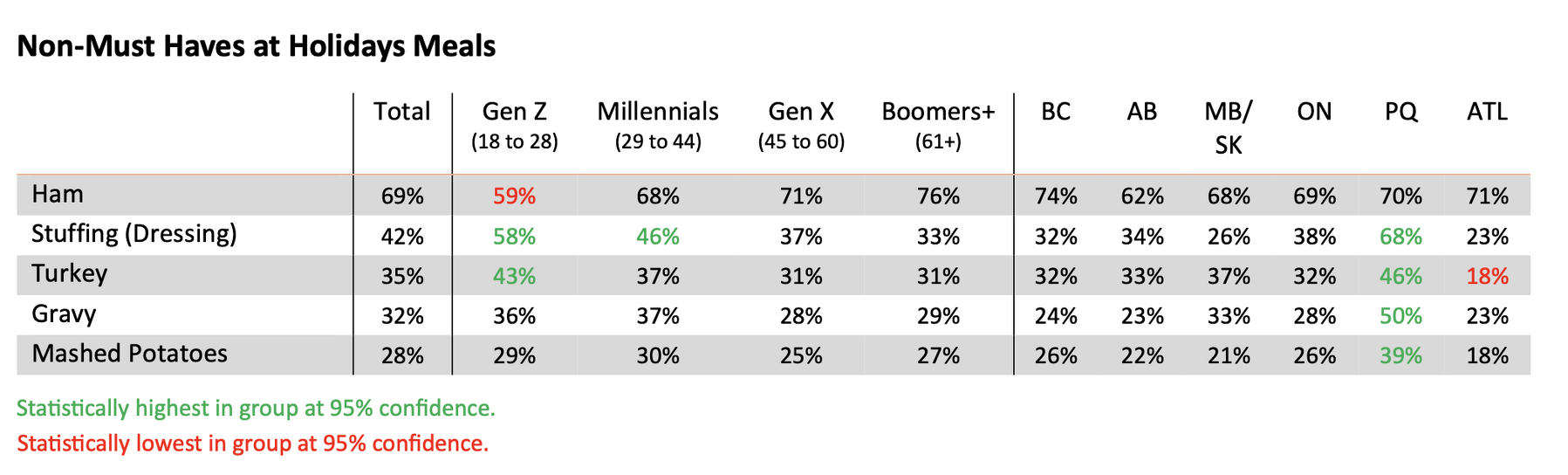
Across turkey, ham, mashed potatoes, stuffing, and gravy, no single item is seen as indispensable by all Canadians. Although the majority consider mashed potatoes (72%), gravy (68%), turkey (65%), and stuffing (58%) “must-have” items, there are differences in how Canadians prioritize these foods. Notably, around one-third report not eating ham (34%) or stuffing (31%), and one-in-five do not eat turkey (21%). These results reflect a broader shift toward personalization and openness to introducing or elevating other dishes.
Generational and regional differences further highlight changing food traditions
Boomers+ are significantly more likely to view ham as non-essential (76%), while Gen Z is much more likely to deprioritize stuffing (58%) and turkey (43%). Quebecers also consistently stand apart, showing lower attachment to traditional holiday dishes and significantly higher likelihood of viewing multiple items—especially stuffing, turkey, mashed potatoes, and gravy—as non- essential. These patterns highlight that classic holiday foods are far from universally valued across Canada.
Gravy remains critical to the holiday meal, except in Quebec
Despite softening views on many traditional dishes, gravy stands out as a holiday staple for most Canadians. Two-thirds (67%) describe gravy as the “backbone” of the holiday meal, reflecting its central emotional and culinary role. Quebec again diverges, with higher proportions who would pass on gravy (22%) or “take it or leave it” (28%), indicating a distinct regional taste profile for holiday flavours.
Holiday cooking evokes widespread frustration, particularly among younger Canadians
Although 42% report no issues with holiday cooking, the majority (58%) cite some frustration, most commonly feeling they are “slaving in the kitchen” (25%), managing too many recipes (14%), or handling picky eaters (14%). Younger Canadians, specifically Gen Z (73%) and Millennials (66%), are significantly more likely to express these concerns, pointing to time pressure, effort, and multi-tasking demands as key pain points. In contrast, older generations report fewer challenges.
Holiday dining remains meaningful but is becoming far less one-size- fits-all
Traditional dishes continue to play an important role, but expectations are no longer uniform and differ sharply by age and region. Brands that recognize these shifts have an opportunity to help Canadians redefine their holiday meal experience, whether by simplifying preparation, offering modern alternatives, or tapping into the strong emotional resonance of key seasonal staples like gravy.
Methodology
This survey was undertaken by The Harris Poll Canada. It ran overnight on November 11th, 2025, with 1,360 randomly selected Canadian adults who are participating in holiday meals and are online panelists. The results have been weighted by age, gender, region, and education (and in Quebec, language) to match the population, according to Census data. This is to ensure the sample is representative of the entire adult population of Canada. For comparison purposes, a probability sample of this size has an estimated margin of error (which measures sampling variability) of ±2.7%, 19 times out of 20. Discrepancies in or between totals when compared to the data tables are due to rounding.