


 5 Min Read
How Inheritance Is Reshaping Financial Mindsets
The largest wealth transfer in U.S. history is underway, and with it, a shift in how Americans think about money, family, and legacy. In this follow-up to our recent webinar, we explore how this $124 trillion transition is influencing financial behavior across generations.
While many younger Americans expect to inherit sizable assets, few feel prepared to manage them. From emotional readiness to advisor expectations, our study uncovers what today’s consumers need and what financial brands must do to earn their trust.

- 61% of Millennials and Gen Z expect to inherit money in the future
- 1 in 4 say they feel “not at all” prepared to manage inherited wealth
- Only 14% say their family discussed emotional expectations in advance
- 66% of younger Americans want more frequent communication from advisors
- 89% of older and 66% of younger adults trust people over AI for financial guidance
Takeaway: The wealth shift isn’t just financial, it’s emotional. Institutions that lead with empathy and transparency will be best positioned to earn long-term loyalty.
Check out additional, top-tier news coverage of this story in Yahoo Finance, Barchart, and Wealthtender.
Design at Work: How Visual-First Teams Move Faster
Following our joint webinar with Canva, our newest case study explores how visual-first communication is transforming the workplace. While creative teams often juggle too many tools and too few guardrails, forward-thinking organizations are rethinking design as a leadership capability, not just a function.
The study draws from global research conducted by The Harris Poll across 2,400 professionals and highlights how design fluency unlocks speed, clarity, and team alignment in an AI-powered economy.
- 84% say poor visual communication causes confusion and delays
- 88% believe visual fluency is essential for leadership roles
- 90% of Gen Z say they do their best work visually
- Most creative teams use 8+ tools to execute visual work
- Unapproved workarounds are common and risky
Takeaway: Design isn’t just aesthetics, it’s operational strategy. In the AI era, visual fluency is a competitive advantage, not a nice-to-have.
EV Demand Isn’t Dead, It’s Evolving
As federal tax credits for EVs phase out, we explored what’s next for consumer interest in electric vehicles. Despite headlines predicting slowed growth, our research shows demand is shifting, not disappearing.
EV hesitation is increasingly driven by cost, charging concerns, and infrastructure, but not by interest itself. To drive adoption, automakers and policymakers must tailor strategies to these evolving pain points.
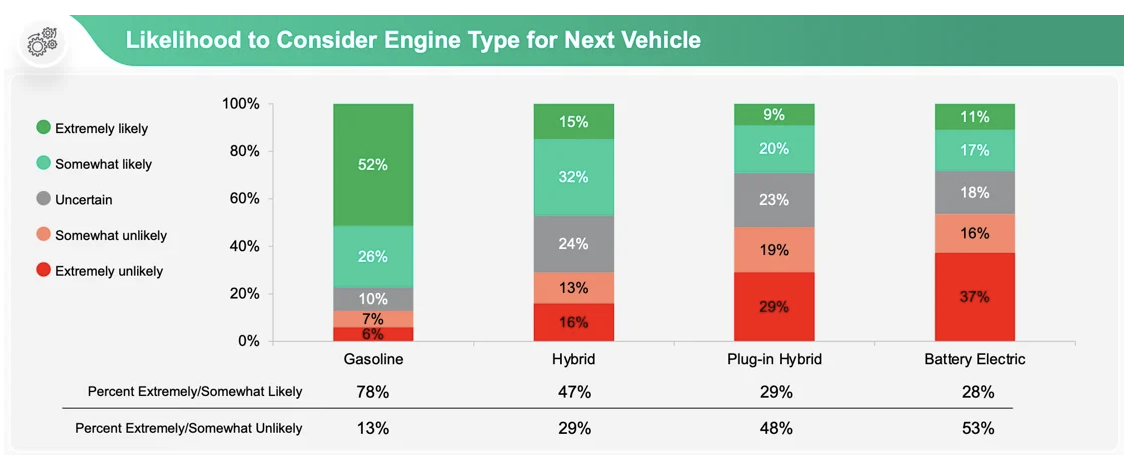
- 6 in 10 Americans still say they’re open to buying an EV in the future
- 70% of potential buyers cite cost as a top barrier
- 67% want to see more public charging stations
- Only 28% of Americans know whether their utility offers EV charging rebates
- Gen Z and Millennials remain the most open to EV adoption if incentives align
Takeaway: Demand for EVs is alive, but more conditional. The brands that win will meet buyers with practical solutions, not just promises.
Check out additional, top-tier news coverage of this story in Politico.
Behind the Myths: Why Women Still Skip Mammograms
In honor of Breast Cancer Awareness Month, The Harris Poll partnered with Hologic to explore what’s keeping women from getting screened. Despite years of education campaigns, myths about pain, timing, and risk continue to hold women back, especially younger and first-time patients.
Our findings reveal that awareness isn’t the issue. To close the screening gap, healthcare providers must communicate proactively, empathetically, and often.
- 62% of women who’ve never had a mammogram think they don’t need one yet • 50% are unsure when or how often they should get screened
- 34% of women under 40 say fear or anxiety has kept them from scheduling
- 1 in 3 believe mammograms are extremely painful, though experience shows otherwise
- Women with regular screening habits cite provider communication as a key driver
Takeaway: Misconceptions, not access, are the quiet barrier. Clear, frequent communication can turn awareness into action, especially for at-risk groups.
Local Loyalty: What Makes a Grocery Store Feel Like Home
When it comes to grocery shopping, convenience matters, but connection matters more. In this new survey, shoppers say they’re loyal to stores that feel rooted in the local community.
Consumers are placing growing importance on how supermarkets support their neighborhoods, employees, and values. For grocery brands, that means reputation is built aisle by aisle, online and off.
- 78% of Americans say they shop regularly at a “go-to” grocery store
- 71% are more loyal to stores that support local organizations or causes
- 67% say how stores treat employees impacts where they shop
- 63% prefer retailers that reflect their personal values
- Community-based messaging boosts trust across generational lines
Takeaway: Local is a location and a feeling. Supermarkets that act like neighbors, not just businesses, earn deeper customer loyalty.