




 6 Min Read
In an environment where the costs of goods can vary dramatically due to the tariff rate, labor costs, and supply chain difficulties it is important to estimate customers’ reaction to price. Many companies take the passive approach by matching the competition, relying on distributor recommendations or demands, or applying a static markup on their costs. These methods don’t directly consider the customers’ willingness to pay and can easily lead to leaving money on the table. Larger companies often create models based on actual sales data, which works well if data integrity is maintained, but it is more challenging when introducing new products without historical performance indicators. That leaves survey research to estimate potential customer response to pricing.
We don’t always recommend a single model to clients for market research, nor are we blind to the weaknesses of stated versus behavioral data. However, when done effectively, pricing research can be an essential tool in a product or brand manager’s toolkit for determining go-to-market pricing or responding to inflationary pressures. Here are three commonly used models and the scenarios in which you might consider each.
Gabor Granger Model
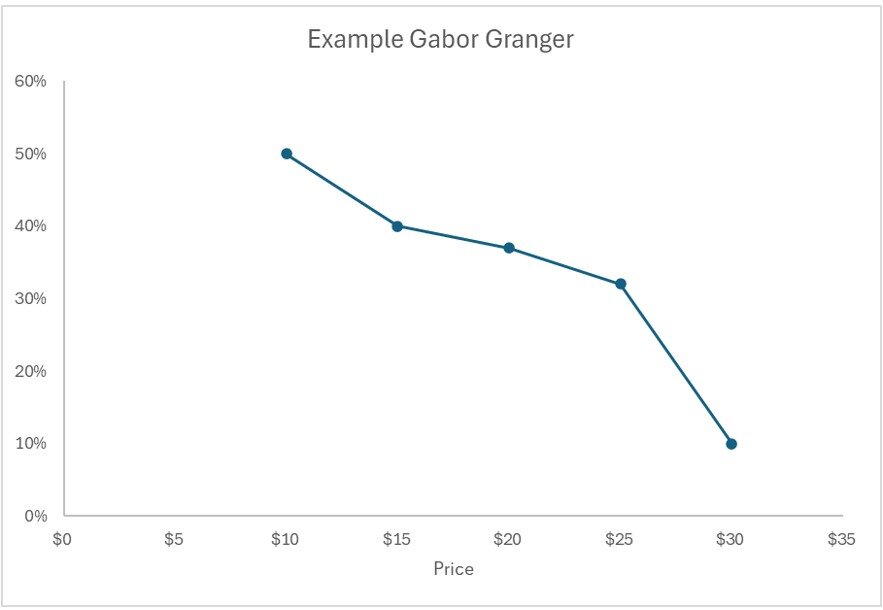
The first model is the Gabor Granger model. This approach is useful when you know the price points you want to test in the market, and you want to measure market potential. It works especially well in low-engagement or technical categories where consumers might not have clear expectations about reasonable prices. In this model, you start by asking participants how likely they would be to purchase at your go-to-market price. If a respondent is likely to purchase, you raise the price and ask again, continuing until you reach the highest price you want to test, or until the respondent is no longer likely to purchase. If a respondent is not likely to purchase at the starting price, you lower the price and repeat the question until they are likely to purchase or you reach the lowest price you want to test. It’s easy for respondents to manipulate these questions, so it’s important not to test too many price points—we recommend testing no more than five. The greatest weakness here is the potential conditioning of respondents, which can lead to artificially steep drop-offs at higher price points. This model also doesn’t consider competitor products or diagnose why people might choose to opt out, which require more complex models.
Van Westendorp Model
The Van Westendorp model is focused on customer expectations. It begins by prompting customers to make an inherent trade-off between price and quality. Unlike other models, respondents aren’t provided with specific prices. Instead, they are asked to enter their own price expectations at four different levels:
- Price so low that you would doubt the quality
- Price you would consider a bargain
- Price you would consider getting expensive, but doable
- Price too expensive to consider
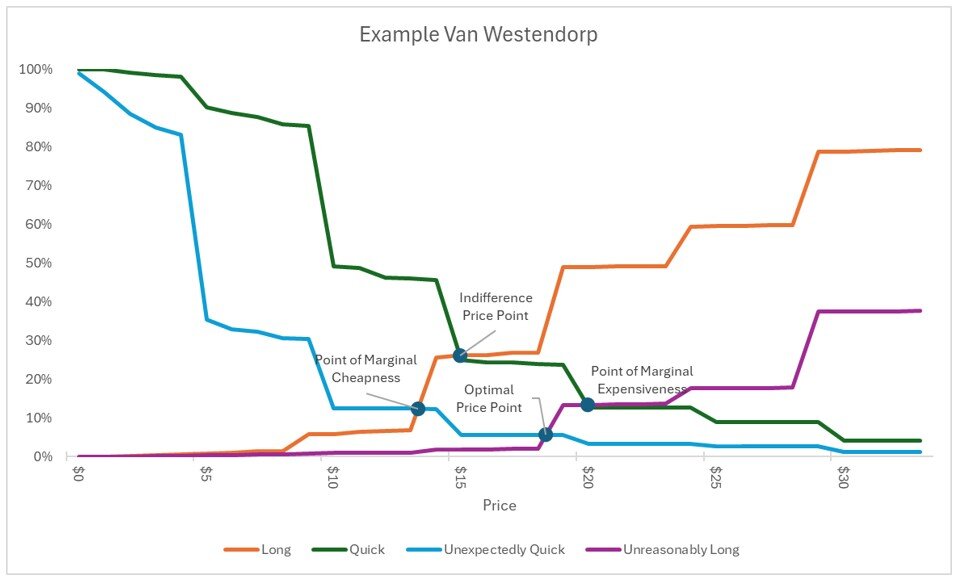
Sometimes you get wild answers like purchasing TVs for $1, but luckily this model is very robust to outliers. That person who said $1, we probably don’t know their real low price, but you can expect it to be below the median so when we graph the percentile curves, like in the graph below, across the entire sample you get a reasonable range of prices. If your strategy is to maximize share then you normally want to go towards the Point of Marginal Cheapness or in the graph to the left price it around $13. If you want to market as a premium brand the customer expectation is closer to $20. You can also see where the large jumps in the graph occur where lots of people have expectations at that price level. Furthermore you can even add in the purchase likelihood questions to get a rough size of market potential and generate a demand curve (called the Newton Miller Smith extension). This technique is wonderful at getting a sense of what the customer expects, but it doesn’t take into account competitive pressure or diagnosis what parts of the product people really value. To answer these questions in a survey the real solution is a type of conjoint analysis.
Conjoint Analysis
Conjoint analysis is considered the industry standard for diagnosing which product features matter most to customers and for simulating purchasing behavior in a competitive environment. While it cannot replicate real-life behavior perfectly, it does a good job of mimicking the choices consumers make when faced with actual purchase decisions.
There are several variations of conjoint analysis, which can be tailored to different product categories and research objectives. For example, if you’re studying purchasing decisions for toothpaste, you might design a “shelf-based” simulation that focuses heavily on packaging, brand, and price. In categories like automotive, you would typically present much more detailed information about product features and benefits. Other approaches include adaptive conjoint, where respondents build their ideal product configuration (such as customizing a computer online), or menu-based conjoint, which is often used to test how consumer choices change when certain options—like a value menu—are removed.
The essence of conjoint analysis is to show respondents different combinations of features, prices, and brands, and then observe their choices or likelihood to purchase. By systematically varying the product attributes across scenarios, you can deconstruct respondents’ preferences and figure out which features are most influential in their decision-making process.
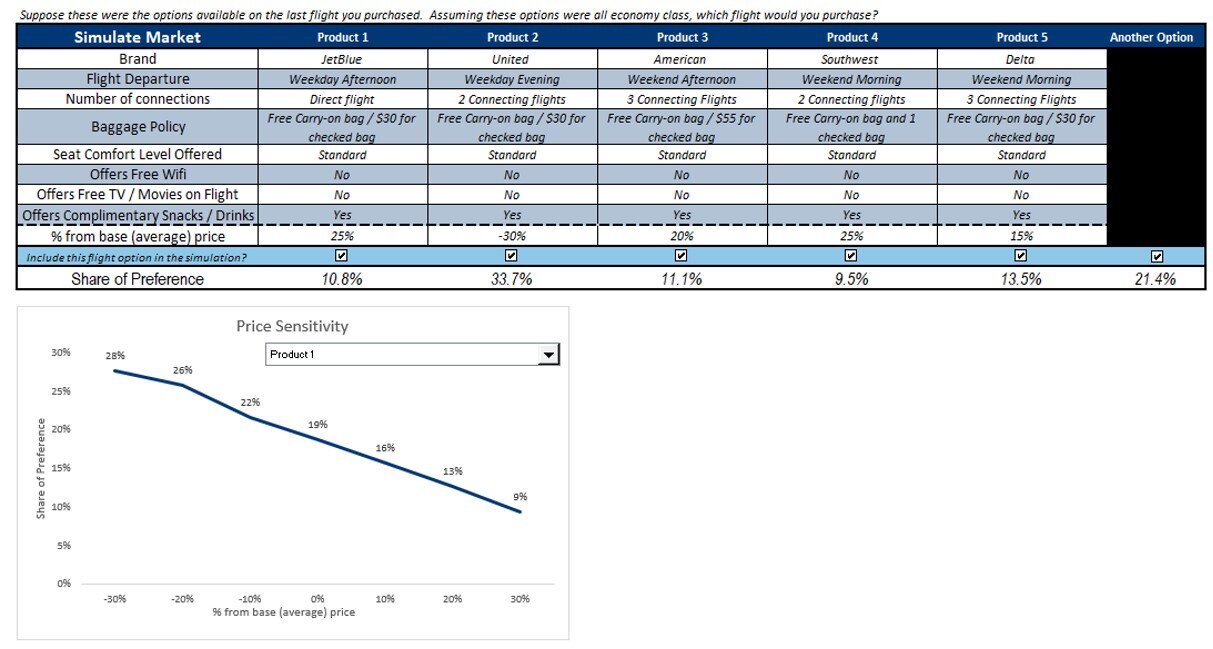
After data collection, the analysis produces a set of “utilities” or “part-worths” for each feature level. These part-worths can then be used to simulate a wide range of market scenarios. For example, you can estimate what would happen to your market share if you raised your prices but your competitors did not, or if you introduced a new feature. The model can incorporate competitor reactions and highlight which product aspects make your brand uniquely valuable and more resilient to inflation or competitive pressure. You can even include actual sales or distribution data to further refine these simulations and account for factors like limited availability or marketing spend.
If you are concerned about finding the right price, don’t just rely on intuition or take orders from distributors or competitors. Instead, conduct research and select prices that accurately reflect your brand’s value. Ask consumers what they value and price accordingly. Use research findings to inform distributors and justify price premiums. The small investment in research can yield enormous dividends and prevent costly mistakes, especially as your product reaches large-scale distribution.