

 5 Min Read
An America This Week Special Report
Good afternoon from Los Angeles, where our CSO, Libby Rodney, and I spoke on panels at the 28th annual Milken Institute Global Conference.
This year’s theme was “Toward a Flourishing Future,” which focused on translating recent disruptions and innovations into meaningful actions to create healthier, prosperous lives for more people.
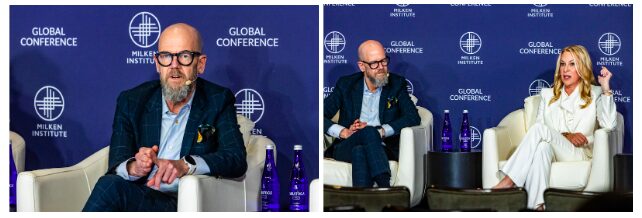
I joined the panel on corporate trust with X CEO Linda Yaccarino, TIME CEO Jessica Sibley, Pew Research Center President Michael Dimock, and U.S. News & World Report CEO Eric Gertler. See the whole discussion here.
Libby led a climate panel that remains a priority among business leaders. I also joined a private CEO roundtable delving into current and emerging trends and challenges shaping the landscape of 2025 and beyond.
Let’s dive into what we talked about.
To track the Milken vibes, the second most popular word after AI is tariffs. Business leaders are remarkably tempered at 100 days into the new administration, showing restraint over panic in our polling in WSJ. While eight in ten are concerned about their business’s current political and legal climates, over half (55%) say recent executive orders haven’t impacted (or have positively impacted) their competitiveness. And two-thirds even think the business climate is the same or better than expected (66% v. worse: 37%).
Now, let’s turn from POTUS to the public. In last year’s Milken Institute-Harris Poll Listening Project, American business leaders and citizens lived in different realities. There were over 31%-pts or higher gaps on respective economic outlooks, and 19%-pts+ gaps on the future.
But while last year may have been different takes, our new Milken data shows the trust between business and their customers has frayed:
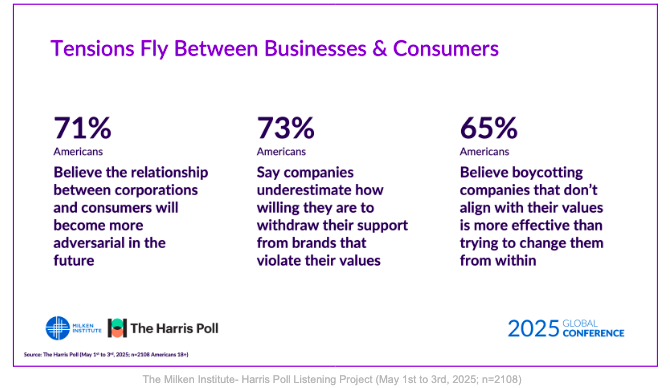
More than ever, consumers feel under siege from businesses. Half (50%) blame corporations for higher prices of goods and services (v. the government: 50%). As for those feeling stuck or falling behind financially, they are pointing both to business (39%) and the government (30%) over their own financial decisions.
Inflation-weary buyers are turning their sights on the C-suite. Many believe companies charge higher prices (72%) or use tariffs (60%) to boost profits artificially. Another four in five (80%) argue companies often sell lower-quality goods while charging higher prices. Notably, in last May’s Axios Harris Poll 100, reputation declines were recorded among 71% of companies in our index. (The new study will be out on May 20th.)
This corporate backlash has only grown from our previous research with U.S. News & World Report and our 2024 WEF reporting, which found significant disconnects between Americans and business leaders around values and trust.
Inflation cynics are one reason, but the cultural issues are also harming business trust. Over three in five (78%) say companies are getting into more controversy trying to appease both the left and right. And over half (56%) say it’s a marketing ploy when companies voice opinions on social issues rather than an authentic opinion (44%). That’s in stark contrast to the (75%) of business leaders who feel comfortable expressing their views about policies to the public.
It’s reached the point where most Americans believe today’s CEO should be seen and not heard. It began with in-depth research on the Opt-Out Economy, where consumers felt betrayed by shifting politics that forced a mental re-appraisal between their brand perceptions and values. We’re fond of saying that if you have a red or blue brand, you have less of a green one.
Most Americans would like businesses to cool it with the virtue signaling unless they have a track record on the issue at hand. Today, less than a third of Americans (29%) say companies should frequently take public positions on social issues, vs. occasionally (47%) or rarely or never (24%). Now, consumers say, if you speak out, ensure it’s related to your business operations.
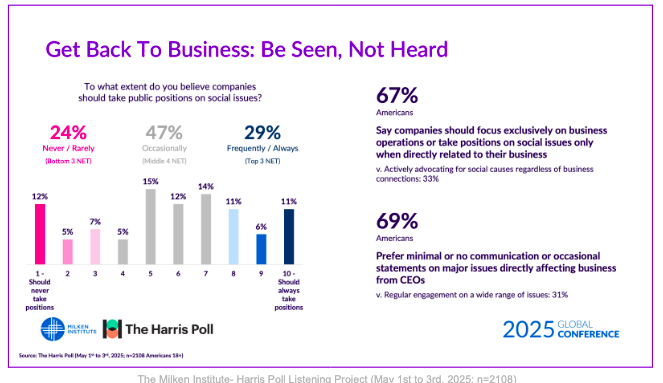
On this last point, consumers say speaking out can be effective if you take consistent positions aligned with stated company values (47%) over staying completely neutral on all social issues (29%) or responding only when it impacts you directly (24%).
Ultimately, to improve trust, stop talking and start doing. I’ll put words in their mouth, but they say that the average business has far more press releases flying around than actual programs. “Put your head down and do the work,” as Linda said in our panel.
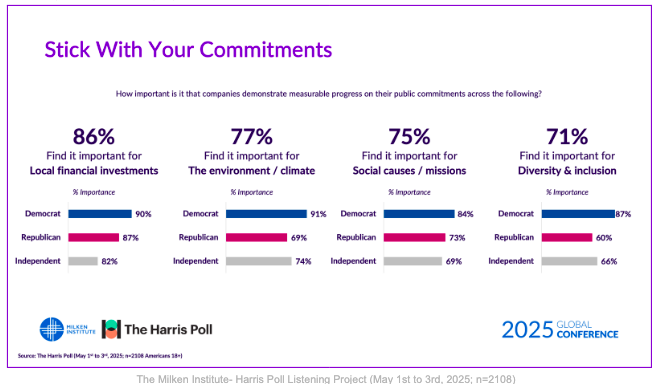
Consumers find it essential that companies demonstrate measurable progress on their public commitments when made around local financial investments (86%), the environment (77%), social causes (75%), and even DEI (71%). Backing up your talk is a sentiment felt across the political spectrum, even on these more partisan aspects. A plurality even says that if a company has previously committed to diversity and inclusion narratives, they expect them to maintain all commitments regardless of the political climate, over-adapting to the political environment, or reducing public messaging.
American consumers think businesses could do better by them in not just charging fairer prices but also being better employers. After all, every kitchen table conversation across America is about balancing the checkbook and worries over job security, fair pay, and the like.
Focusing on employees is a trust builder. Two-thirds of Americans (67%) say when choosing where to shop, I consider how a company balances employees’ well-being with other business priorities. Further, Americans want businesses to prioritize economic stability and job creation as well as diversity, equity, and inclusion for their employees (52% and 27%) more than political neutrality (19%) or even shareholder returns (13%).
Further, American employees wish businesses would truly understand that financial stability (40%), fairness and equity (39%), and economic mobility (30%) are their most important concerns today. As for the CEO front, consumers and employees value those CEOs who create strong workplace cultures regardless of external political pressures (both 83%).
Finally, Americans want leaders to back it up with reason. Most Americans (83%) will trust companies where leadership clearly explains how their decisions serve business performance and employee well-being. Consistency, values, and character are the DNA of trust today.
- John Gerzema