



 7 Min Read
On January 20th, 2025, U.S. President Donald Trump announced he would impose 25% tariffs on Canada and Mexico starting on February 1st. While many people believed that it was just a negotiation tactic with some false starts and stops including the appointment of a “fentanyl czar,” by the middle of February it was clear that the president was serious. The following months saw the escalation of a trade war between the two countries, as Canada retaliated with tariffs of its own, and the Trump administration imposed additional measures targeting the automotive, steel, and aluminum industries.
These trade policies, combined with a series of controversial comments by the president regarding Canada’s sovereignty, have led to a renewal in Canadian economic nationalism. A “Buy Canadian” movement emphasizing support towards domestic brands while implicitly eschewing American companies has developed organically in the country and has received widespread support from political and business leaders.
How does this political context affect the brand image of American companies in Canada? Are they taking heat by proxy for their national origins? We measure the impact of this escalating trade war in the Canadian public view of these American brands.
The QuestBrand Platform
The Harris Poll’s QuestBrand platform is an industry-leading brand tracking tool that tracks consumer sentiment and perceptions on a daily basis. Respondents are asked about their impressions of brands by answering questions covering a range of topics such as the product quality, likelihood to consider or recommend it for future purchases, and the brand’s irreplaceability.
The data is collected daily and thus provides a real-time snapshot of target audience perceptions. We start to examine this data to see what type of shift has occurred since the start of the tariffs.
Canadians are Favouring Domestic Brands
Canadian have shown a clear preference for domestic brands since the start of 2025 in the QuestBrand platform. They have seen their metrics generally improve while American companies have received a neutral impact at best, and a decrease at worst.
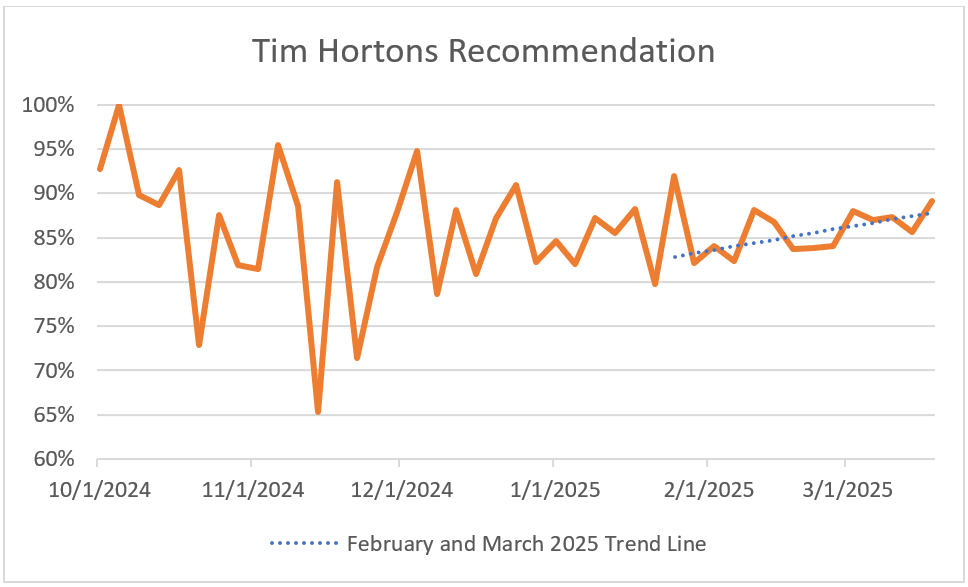
The effects of the trade dispute are particularly noticeable in product categories that are highly substitutable, such as food and beverages. For instance, between October 2024 and January 2025, QuestBrand data reveals that Tim Hortons had been experiencing a slight decrease in consideration (the proportion of respondents considering patronizing Tim Hortons in the next 30 days) amongst Canadian respondents.
February and March 2025, meanwhile, saw a reversal of that trend, with consideration now growing at a rate of nearly 3% per month. At the same time, Starbucks, a rival American coffee chain with a similar footprint in Canada, has seen a sharp decline in consideration of almost 5% per month since February 2025.
Similarly, domestic pizza chains like Pizza Pizza and Pizza 73 have grown in consideration since February, at a rate of 0.17% and 5.56% per month, while American competitors like Pizza Hut (-0.92%) and Papa John’s (-3.92%) have seen a decrease over the same period.
The effect is significant and suggests Canadians are substituting foreign products for domestic ones. However, some American brands like Starbucks and Pizza Hut have seen their irreplaceability (or the perception that the brand cannot be replaced) remain neutral or grow over the same period in QuestBrand. Canadians recognize these brands’ unique value proposition but are deciding to forego patronizing them for the foreseeable future.
QuestBrand’s unique multifaceted data thus highlights the strategic opportunities for both Canadian and American companies. Domestic firms have an opportunity to attract a new client base. And, if current trends continue, if the Canadian economic nationalism sentiment ends up being a transitory phenomenon, QuestBrand data suggests American companies have the opportunity to quickly regain market share in the country, particularly if they can emphasize their uniqueness vis-à-vis their competitors. Consumer still recognize their value in the commercial landscape.
Nationalism as a Social Movement
Questbrand data also suggests that economic nationalism is a social movement first and foremost, tied to a broader renewal in Canadian patriotism and unity in the face of a perceived common threat. Indeed, in addition to consideration, the platform reveals that Canadians are increasingly recommending domestic brands over American owned companies.
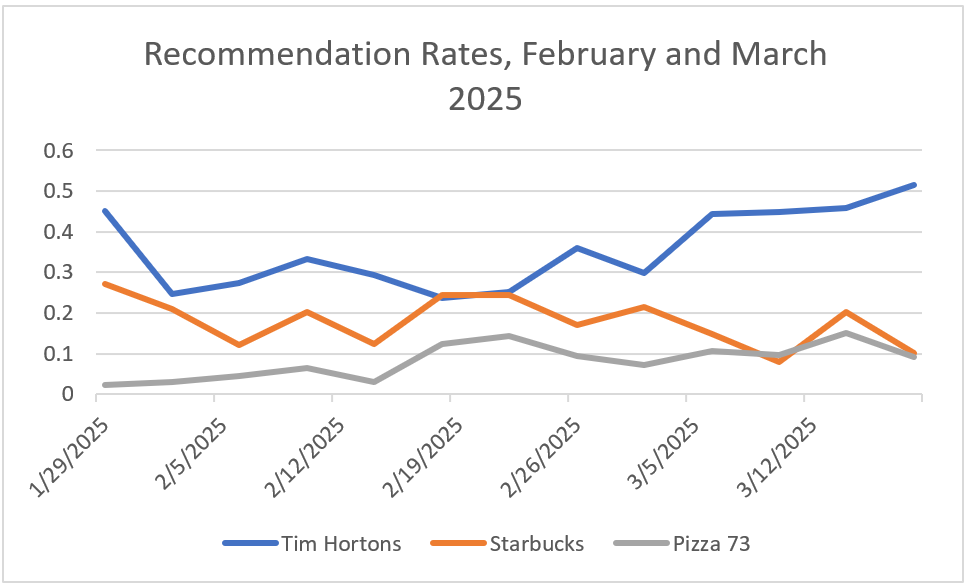
Since February 2025, Pizza 73’s recommendation has grown at a monthly rate of 5.75%. Meanwhile, Tim Hortons has reverted from a 30-day rate of -3.38% to 10.73%, while Starbucks’ has fallen to -5.26% since the imposition of tariffs.
The growth in recommendation rates for Canadian brands has generally outpaced the consideration rates. This suggests that encouraging others to support local brands is an integral component of the “Buy Canada” movement. As consumers decide to eschew American companies, the ongoing trade dispute presents an opportunity for Canadian brands to promote themselves and reach a new audience.
Moreover, the QuestBrand platform’s data suggests economic nationalism is not limited to a support for Canadian brand, but also includes an outright rejection of American products, even in industries where no clear substitute exists. The impact is particularly noticeable for brands that are associated in some way with the Trump administration.
For instance, Tesla, whose CEO is currently employed as a special government employee by the president, has seen its consideration rate drop from 37% in October 2024 to 27% at the end of March 2025, and its broader support sour since the start of the year. Moreover, perhaps as a result of the administration’s embrace of cryptocurrencies, exchanges like Coinbase have also experienced a decrease in consideration since February 2025 at a monthly rate of 1.5%.
Canadian consumers are angry and are looking to retaliate in their own ways to the perceived attacks from the United States.
Brand Equity Transcends Borders
However, QuestBrand data suggests that not all industries have been affected in a similar fashion by this renewal in economic nationalism. Clothing, for example, is generally seen both as an investment (in the sense that a piece of clothing will be worn multiple times as opposed to a consumable food product) and as a form of personal expression. Therefore, brands generally enjoy high equity, and consumers might decide to remain loyal to their favourite brands even if they are foreign. Substitutionally is significantly lower in that industry.
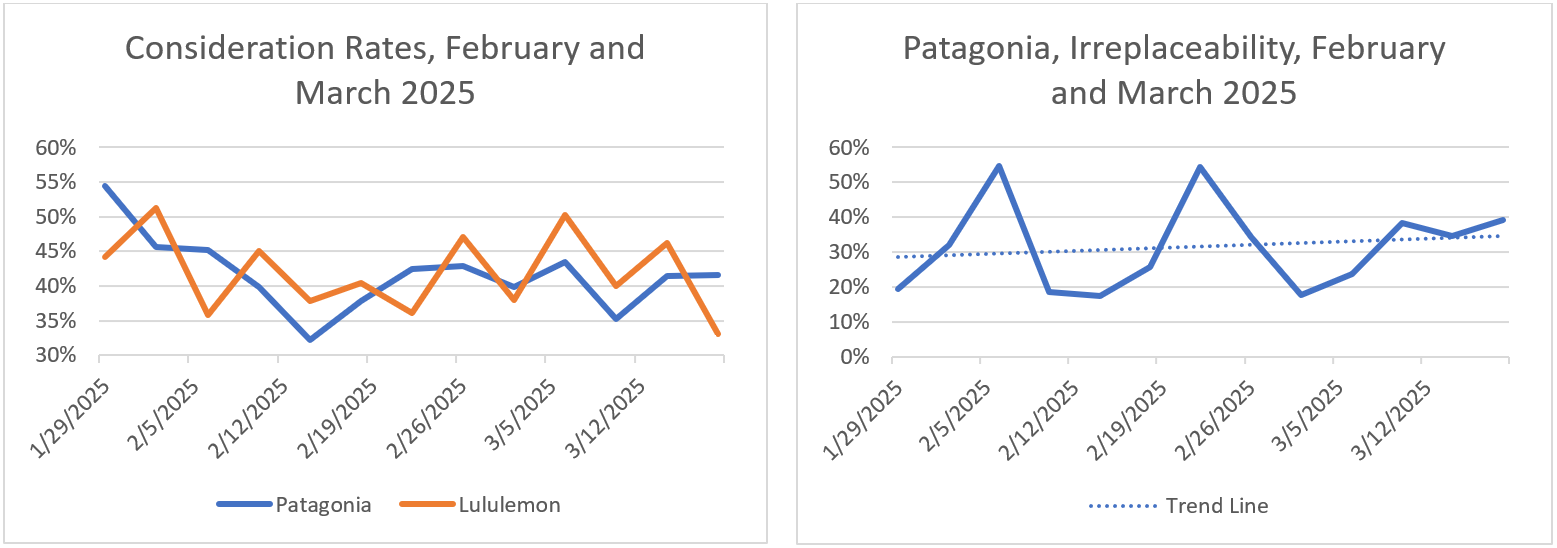
For instance, both Lululemon and Patagonia, two brands operating in the athleisure segment, have seen their irreplaceability grow in QuestBrand over the last six months in spite of the change in sentiment. The latter has been successful at positioning its unique value proposition in Canada despite being US-based and has seen its irreplaceability increase at a rate of 3.8% per month since February 2025.
Yet, both brands have also experienced a directionally significant decrease of at least 2% per month in consideration since the start of the year, which is more likely to be explained by a general drop in consumer discretionary spending then by a shift in preferences towards Canadian products. It is noteworthy that Vancouver-based Lululemon’s consideration and recommendation have both been decreasing since February, but at a monthly half that of its American competitor.
In short, QuestBrand is suggesting that other broader macroeconomic factors are at play, and that understanding a firm’s positioning in its competitive environment is helpful at separating the effect of different consumer phenomena.
The ongoing trade dispute between Canada and the United States presents both opportunities and challenges for domestic and international companies. The QuestBrand platform reveals that Canadian consumers are more likely to shift their purchasing habits towards homegrown brands, particularly if they operate in an industry with high substitutability and low barriers to purchase.
American brands, meanwhile, can maintain their footing in the Canadian market by highlighting their uniqueness compared to their peers and by downplaying their links with the United States, for instance by embracing Canadian values or promoting their local manufacturing or distribution activities. In either case, the current market uncertainty highlights the need for the type of high-quality, real-time data that Harris Poll’s QuestBrand platform can provide.
This exploratory analysis was conducted on a small subset of Canadian and American companies for which QuestBrand data was available. The results should be interpreted with a certain amount of caution and may not be generalizable. This report was supplemented with external sources. Tracking companies in a wider array of industries and over a longer period would help strengthen these conclusions. The release of the upcoming Harris RQ tracker will provide us with a more robust sample of companies to analyze.