

 4 Min Read
While public attitudes toward mental health are improving, stigma and barriers to care remain deeply rooted across the country.
New research from The Harris Poll and the American Psychological Association reveals that while mental health discussions are becoming more common, cost, insurance coverage, lingering taboos around mental health and other issues still prevent many from seeking the help they need. For younger generations, the desire to be open about their mental health often clashes with the fear of judgment, leaving them in a vulnerable and silent space.
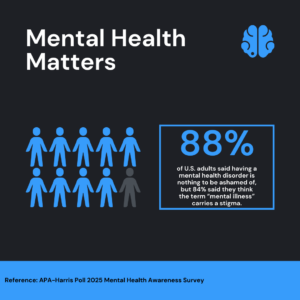
Nearly 9 in 10 U.S. adults (88%) say having a mental health disorder is nothing to be ashamed of. But 84% say the term “mental illness” still carries a stigma. More than a third of adults (35%) say they would view someone differently if they learned they had a mental health condition.
Still, most U.S. adults feel good about their mental health and are open to discussing it. A majority of U.S. adults (51%) feel positive about their mental health right now, and more than 4 in 5 adults (83%) say they are generally comfortable talking about their mental health. Yet for younger adults, those conversations may still be hard to start.
Young adults, however, were both more likely to feel negative about their mental health and less likely to talk about it. Nearly a quarter of younger adults said they are not comfortable talking about their mental health – more than any other age group (23% ages 18-34 vs. 14% ages 35-54 and 14% ages 55+). More than half of younger adults (52%) also say they have withheld information about their mental health from friends or a health care provider, compared with 42% of adults ages 35-54 and 25% of adults ages 55 and older.
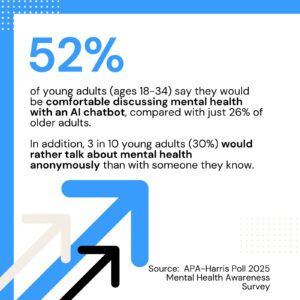
Young people are also seeking new ways to open up — on their own terms. About half of young adults (52%) say they would be comfortable discussing mental health with an AI chatbot, compared with just 26% of older adults.
In addition, 3 in 10 young adults (30%) would rather talk about mental health anonymously than with someone they know. These findings suggest younger generations may feel safer talking about mental health when they can maintain distance or anonymity.
These findings suggest that emotional safety, not just access, plays a key role in how people engage with their mental health. Feeling safe (55%) and experiencing relief (54%) were the top reasons adults said they chose to share their struggles with someone else.
Interest in qualified care is high. More than 4 in 10 U.S. adults (45%) say they’ve sought mental health care in the past, and another 17% want to seek care in the future. Among those who have sought help, most were interested in therapy (70%). Fewer pursued goals related to medication (48%) or formal diagnosis (39%).
Even self-care — a widely accepted and celebrated way to manage mental health — comes with emotional baggage. Nearly all U.S. adults (96%) say self-care is important, and 63% report doing it at least once a week. But 21% say they feel guilty for taking time for themselves, and 27% say they feel lazy when they’re stressed. Those feelings are especially common among women and young adults.
For all the progress made in reducing stigma, many Americans still don’t feel free to ask for what they need, whether that’s time to rest, someone to talk to, or help from a professional. A full 41% of U.S. adults say they’re often uncomfortable asking others for help. And when it comes to accommodations for mental health at work or school, more say they’d be uncomfortable asking for support around mental health (29%) than physical health (21%).
The findings are a reminder that awareness alone isn’t enough. If Americans are going to thrive mentally and emotionally, they’ll need more than conversations— they’ll need safe spaces, affordable care, and a cultural shift that encourages people to rest, speak up and reach out without fear.
This survey was conducted online in the United States by The Harris Poll from April 18-25 2025, among 1,076 U.S. adults ages 18+. Figures were weighted where necessary to bring them into line with their actual proportions within the US population. Respondents for this survey were selected from a pool of potential respondents who have agreed to participate in The Harris Poll’s online research.